Longways Dances
Alphabetically:
Links to dances on other pages
Barbara's Waltz 


Formation: Longways duple.Dance: Colin Hume, 2020.
Music: Dmitri Shostakovich wrongly known as Jazz Suite, Waltz No. 2
Skip to instructions
I gave a talk at the “Playford Then and Now” virtual festival run by The Historical Dance Society in November 2020 and included this as an example of how I compose dances, so I'll go through that here — you don't have to read it in order to call the dance! I started by playing the recording of the tune at youtube.
Some dance writers always start with the music. Gary Roodman from the States, for instance, will find a good tune, whether it's an old one by Mozart or Handel, or a new one by Jonathan Jensen or Dave Wiesler, listen to it over and over, and then create a set of figures which match the music perfectly. A few months before the festival I was talking on Skype to Barbara Shaffer, an English and International dancer, and she told me very firmly that while in lockdown I should be writing dances, so I decided to write her one. I know she loves waltzes, and I'd thought of writing a dance to this tune for some time, since I heard it played by John and Mary Brock of the Weston Country Dance Band. They had cut it down to a standard 32 bars, but I'd heard it before and knew that there was really another 4 bars at the end. So what goes through my head when I listen to this tune? I hear the first 8 bars as a phrase, and the second 8 bars as an answering phrase. Then there's a 4-bar phrase and you might consider the next 4 bars as an answering phrase, or you might hear the whole thing as an 8 bar phrase in similar style to the first two but not an answering phrase. And then we come to a dramatically different style of music with lots of shorter notes to undercut the schmaltzy feel of the preceding 24 bars: a 4 bar phrase, the same phrase again, and then an answering phrase which rounds the whole thing off. To me it's those last 12 bars which really set this tune apart, so I want to put in some moves which fit those three short phrases — preferably a similar move done three times. And what immediately sprang to mind was right hand to right with partner: balance forward, two, three, back two three, change places turning the lady under — the American term for that last bit is “box the gnat” for some reason! You get that in the well-known version of “Duke of Kent's Waltz” by A. Simons, though it's actually a fabrication — see my interpretation (which is never going to replace Bert's)! But you wouldn't want to do that three times in a row with your partner, even using different hands, so let's have the first corners — first man and second woman — do it first. Then the second corners. So you've all changed places on the diagonal, you're progressed and improper, and the final box the gnat with your partner brings you back to your own side.
That's the end of the dance. Don't believe anyone who tells you that writing a dance is a linear process. It can be, but sometimes you start at the end and work back; sometimes you start in the middle and then work in both directions.
So we've got the progression in the last 12 bars… the first 24 bars go nowhere! But they need to go nowhere in an interesting and satisfying manner.
I'd already written a very complicated dance — The Grandparents' Waltz — for Barbara and her husband Malcolm in 2003, so this time I'm going for a simple one, that an average caller can call and average dancers can get through. No just get through, but dance well and enjoy. I know I have a reputation for writing impossible dances, but they're not all like that — some people say I've mellowed.
But I called this at a memorial dance for Barbara in 2025. I have a video (which I'm not going to show you) of the dancers at the bottom of the hall, and it's complete chaos! People didn't move fast enough to get the star round three-quarters, and they were totally thrown by the end effects — neutral couples were trying to join in the stars — and the concept of going round people from a different minor set was too much for some of them. Yes it's an easy dance for two people in lockdown, but not in real life. See my suggestions below the instructions.
So what are our options? I want some spacious movement at the start, as a real contrast to the close contained finish. We could do a right-hand star or circle left for four bars — four waltz steps — and then back the other way, but that's a bit mundane, and I want the next 8 bars to be an answering move just as the music is an answering phrase. We could circle left for 8 bars and then back for 8 bars — but that's dropping it down to the barn dance level! And a star or circle really isn't such a spacious move. In my talk I said I had thought of circling left for four bars and all casting out over the left shoulder to dance single file in the other direction. That really opens things out, provided the dancers aren't scared of using the space (which some are). And then the answering move is circle right, cast out right shoulder and go back the other way. Gary Roodman uses that to great effect in his waltz-time dance “Turning by Threes”, but he does it in 2-bar chunks rather than 4 so no plagiarism there! And then afterwards I realised I had already forgotten what I had written — it's a star not a circle. I had also forgotten (at this time of Zoom dances for just one or two people) that the four dancers in the minor set don't have as much space as I was imagining — there are other minor sets above and below them, as John White from Philadelphia pointed out. Rather than force people into their own confined space I want them to go round people from the next minor set, though I know that makes it more complicated. And of course if you're dancing this in lockdown, on your own or with up to three other people, you don't have any other minor sets to worry about so you really can make the casts as wide as you like, provided you go back the same distance in A2 to finish where you started.
So that's the A-music. For the B-music I'm happy to do four changes with hands — two waltz steps per hand, acknowledging people as you go. And then I realised a slight problem. It's usual to have the first corners start a move, but after the final change with neighbour by the left hand they would have to turn back on themselves whereas the second corners should just flow into it.
Barbara said she could remember it straight off — and she loves the tune. In fact as mentioned above she was doing better than me at remembering it!
In October 2021 I at last got to call the dance, at the reduced Chippenham Festival with Boldwood playing the music in exactly the right style, and it worked well.
It's tricky getting the right speed. If you listen to any recording of the music you'll probably agree that it's taken too fast for a country dance, but if I slow it down too much I'm afraid the music will drag.
Everyone refers to it as Waltz No. 2 from Suite for Jazz Orchestra No. 2, but the Wikipedia article sets the matter straight. It's actually from the Suite for Variety Orchestra, of which the seventh movement (Waltz 2) was adapted from the Waltz (eighth movement) of the Suite from 'The First Echelon', Op. 99a (1956).
Barbara's Waltz
| A: | Right-hand star ¾ (till men are below women) and then first corners cast out over your left shoulder, second corners follow your same sex neighbour and loop left shoulder round the two people from the next minor set and up or down the side to finish across from your partner, home but improper. |
| B: | Left-hand star ¾ and then first corners cast out over your right shoulder, second corners follow that same neighbour and loop right shoulder round the same two people from the next minor set to finish home. |
| C: | Four changes with hands — two waltz steps for each. |
| D: | (12 bars): Second corners (first woman, second man) give right hands, balance forward and back; box the gnat. First corners the same. Partners the same. |
I thought I'd written an easy dance, but I was wrong! A three-quarter star is too much for some people, and then involvement with the next minor set… And the end effects can catch out even experienced dancers — I have this all on video! So if you want to call this dance, here are my suggestions.
 Make sure the first corners know who they are, and that the second corners are going to be following their same-sex neighbour for the whole of the A and B sections, until they get back to their home place.
If people get to the end of the set they must loop round an imaginary pair, and this will happen twice.
If couples are neutral they must join in looping round the pair coming towards them, and again this will happen twice.
I've now tried a new approach, and it certainly helped. Instead of just looping round the next pair, walk it through as a left-hand star half-way with them and then move up or down the side until you're opposite your partner — if there's no-one to do it with at the end, do a left-hand turn half-way. When people are comfortable with that, change it into what Fried de Metz Herman calls a “meander”.
If you're late, just get back to your home place in time for the four changes.
The Cambridge Butterfly
Dance: Colin Hume, 2008, revised 2011, 2023.Tune: Traditional Irish. Each line is 4 bars of slip-jig.
| A1: | Lines forward and back. Ones cross and cast (twos meet and lead up). |
| A2: | Lines forward and back. Twos cross and cast (ones meet and lead up). |
| B1: | First corners positions meet, clap both hands with each other on beat 3; fall back 3 steps. Cross right, turn right. |
| B2: | Second corner positions meet and clap; fall back. Cross right, turn right. |
| C1: | Circle left. Circle right. |
| C2: | Four changes with hands. |
First danced at the Stafford Music Day in 2008. The original dance was harder than I realised, and was not suitable for the musicians dancing at the Music Day! I modified it in 2011, but as originally it had the ones improper and I had the men meeting in B1. Then in 2023 (under the gender-free influence, since I was going to call it at The Round) I switched them round so that I could say “first corner positions”. Finally I realised there was no reason to have the ones improper. And I'm sure if I called it at a club which used gendered terms, no-one would notice I was calling it positionally!
I originally called this dance “The Butterfly” after the tune, but when adding it to my website I discovered from Hugh Stewart's Dance Finder that there were already two dances with that title. Since the revised version was first danced in Cambridge, I've renamed it “The Cambridge Butterfly”.
Blareham Reel
Dance: John Smart, probably late 1970's.Music: 32 bar English jigs.
Format: Longways duple.
| A1: | First man reel of three with the twos, pick up partner half-way through in promenade hold, finish the reel and end facing down with the man on the left. |
| A2: | Ones and second lady lead down. Turn alone, lead back, first man pass his partner back to place, second man fall in below the first. |
| B1: | Right-hand star. Left-hand star. |
| B2: | Ballroom hold: Dance round the other couple 1½ to progress (pas de bas). |
Published in John Smart's booklet “Seven Essex Dances”. This is one of the few dances in my repertoire with a pas de bas, so I'm pleased that John has given me permission to republish it here.
Blareham is near Southend in Essex, south-east England. John says: “I composed it so long ago I'd almost forgotten it, it was one of a small number I produced when I used to go to Rochford FD Club to take a member's evening.”
The Fast Packet 
Dance: Bob Lilley, 1988. Music: 32-bar hornpipes such as “Another Fast Packet” by Colin Hume, 2007.
Format: Longways duple. All danced to a step-hop.
| A1: | First corners right-forearm turn 1½ or 2½ to change places. Second corners the same. |
| A2: | First corners do-si-do (lots of time). Second corners the same. |
| B1 | On the right diagonal all clap together, together, Right, on left diagonal together, together, Left; with partner together, Right, together, Left, together, together, both. All that again. |
| B2: | In fours, circle left 1½ (about 5 bars). Half poussette in the same clockwise direction (first corners pushing). |
The Duchess of York Street
Dance: Sue Dupre. Music: Bob Pasquarello, 2005.Format: Longways duple, twos improper
| A: | First lady cast right shoulder, go round the other three, above partner and across, while the others follow close at 2-bar intervals, to finish in a line facing down. From the left: first lady, second man, second lady, first man. |
| B: | Lead down two waltz steps; two-hand turn neighbour half-way. Lead up two waltz steps; two-hand turn neighbour half-way into a column. |
| C: | All set forward diagonally right and left to pass neighbour left shoulder; ones gypsy right half-way while twos cast. Ones cast and lead, twos lead and cast. Now ones above twos, all improper. |
| D: | Take ballroom hold with partner and waltz half-way round the other couple, to finish facing the other couple, man on left lady on right. Balance the ring; cloverleaf turn single on the sides, out and away from original neighbour (men left, ladies right). |
The dance and the tune were presented to Debbi Kanter of Lawrenceville, New Jersey at a celebration on November 4, 2005
Farewell to the Shore
Dance: Daniel Seppeler, 2012. Music: “Ffarwel i'r Marian” (Traditional Welsh).Format: Longways duple improper
| A1: | Men cross and face partner up and down the set; two quick changes without hands. Circle left. |
| A2: | Ladies cross and face partner across the set; two quick changes. Circle left again. |
| B1: | Face partner and change places with neighbour thus: Ladies forward and men backward one waltz step, all one step sideways into a column; another step sideways, ladies backward and men forward one waltz step. All back-to-back partner. |
| A3: | Two-hand turn neighbour half-way and face out; lead out. Lead in, cross with partner, turn single away from neighbour. |
The tune is also used for the circle mixer Farewell Marian by Gwyn Williams which appeared in a leaflet published by the Welsh Folk Dance Society in the 1950s. Gwyn says:
In those halcyon days when one would be out in rural communities three or four nights a week calling at public folk dances, one would often find the growing need for particular types of dances, such as a nice slow “mixer” community dance, for example. In another field of activity, I was always charmed by the traditional harp-melody of “Farwel i'r Marian” (“Farewell to the Shore”). And that is how the dance Ffarwel Marian evolved. But as “Marian” is also a girl's name, it suited a progressive community dance where the man says farewell to his present partner and acquires a new partner at each stage of the dance.
Heidi's Waltz
Dance: Colin Hume, 1993. Music: Dave Brown / Colin Hume, 1993.Format: Longways duple.
| A: | First corners set (in waltz time, so it's three even steps — no bounce); cross right shoulder. Circle left ¾ (all finishing improper). |
| B: | Second corners set; cross right shoulder but do not turn back. Left-hand turn partner on the side. |
| C: | First corners right-hand turn half-way; their partners come in behind them for a right-hand star once around to progressed places (4 bars); all turn single left. |
| D: | Take ballroom hold and waltz once around the other couple. |
Dave Brown wrote the first tune. The second tune is called “Laurie's Waltz” and is dedicated to Laurie Buchanan who now lives in Oregon. I met Laurie on the first “Bare Necessities” tour of England, run by Ken McFarland in (I think) 1991. I wasn't part of the tour, but I went to several of the dances (as did Dave) and got on very well with some of the Americans, especially Laurie. I was asked to write the dance to Dave's tune for Heidi Chapman, who was also on the tour, and decided to write a second tune to it as well.
Norwave
Dance: Cor Hogendijk of Vleuten, Netherlands, 1986.Music: Spagnolette Reformeert (Oud en Nieuwe Hollantse Boerenlieties en Contradansen: Amsterdam 1700)
From the book Dance Search.
Format: Longways Becket. Progression: counterclockwise.
| A1: | Taking hands in lines, set right and left; four slips to the right. Four slips to the left; set right and left. |
| A2: | Three changes, starting right hand with opposite. Swing partner, finishing in original place. |
| B1: | Ladies chain across, and keep left hands joined after the courtesy turn. Pull by left (2 steps), pull by right the next along the line (2 steps); left-forearm turn the next all the way. [If you reach the end of set, the second pull by is with your partner across the set.] |
| B2: | Ladies chain across (to partner). Left-hand star. |
Pins and Needles Roxburgh Castle
Snowflake Waltz
Format: Longways triple, triple progression.Dance: Colin Hume, 2013. Music: Mary Brock, 2007.
| A: | (16 bars): Ones cross down into hey contrary sides. |
| Ones cross down into hey own sides half-way. All back-to-back: one waltz step forward, one right, one backward, one left. [Now 3, 2, 1.] | |
| B1: | (16 bars): Ones with the two couples below them, right-hand star (the snowflake) — at the very top the spare twos and threes do a four-hand star. Threes and twos (including the spare twos and threes at the top) half poussette clockwise. [Now 2, 3, 1] |
| B2: | Ones with the two couples above them, left-hand star. Ones with the twos below them half poussette clockwise. |
Both poussettes continue the way you are going; you can also think of them as top man pushing, bottom man pulling. I would start everything on the right foot, which means that in the back-to-back the step to the right starts with the left foot going across in front of the right foot.
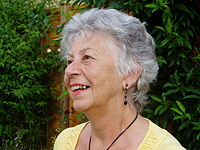
Mary has written a number of successful tunes in a variety of styles. Many of them have had dances written for them by different callers. The Snowflake Waltz was composed at a particularly snowy time, and seemed gentle enough to suggest falling snow, which Colin has translated into a six-hand star snowflake!
The Sound Makers' Waltz Updated 22-Nov-25
Format: Longways duple improper. Updated 22-Nov-25Dance: Olivia Barry, 2020. Music: Colin Hume, 2020.
| A1: | Circle left (4 waltz steps). Balance the ring; Petronella spin one place right (two waltz steps). |
| A2: | Circle right. Balance the ring; Petronella spin one place right. Now progressed and on the other side. |
| B: | Give right hand to partner: balance forward and back; two quick changes with hands. Same again, but instead of turning to face partner at the end stay facing the next couple. |
| C: | With the next couple, twos move (don't cast) up the outside and lead down as the ones lead down through the twos and cast up. All those who did this move give two hands to partner: balance forward and back; two-hand turn half-way, opening up for the circle left. |
Don't change sides when you're neutral. If you weren't involved in the lead and cast, don't do the balance and two-hand turn half-way, so you stay improper. You join in the lead and cast at the end of the next turn, and the two-hand turn half-way will put you on the correct side. (If you can't cope with this, just make sure you start each turn of the dance proper!)
Originally Olivia specified that the second change in the B section was without hands, but people find it easier to give hands and she has now let me change the instructions. To a square or contra dancer this is a square through two hands, and this is certainly an English Country Dance with Contra tendencies so a “balanced square through” is quite appropriate!
The dance is named after a poem my grandmother wrote as she was learning to play the piano with her grandmother. The dance was written for all of the wonderful dance musicians as a way to say “thank you” for the gift of music given each week in the form of online concerts, classes, and recordings during the early days of the Covid 19 pandemic. I wrote the dance shortly after Karen Axelrod's first live Facebook concert, the one where she was playing by herself. As I saw how she was feeling, I also could feel it too, and I started to dance. This is the dance I came up with in that moment.
You can download an MP3 version of 7 times through the tune.
The Stroll
Format: Longways duple.Dance: Colin Hume, Music: Heather Bexon, 2011.
| A1: | All lead up three steps starting right foot, kick left foot forward on the fourth beat; fall back three steps and together. Still facing up, set (R L R, L R L); California twirl. |
| A2: | The same facing down. |
| B1: | Ones cast (twos lead up) and cross to tidal waves with the ones facing out. All set; turn neighbour ¾ to a line of four facing down. |
| B2: | All lead down (in the same style); fall back and bend the line. Circle left half-way; twos California twirl. |
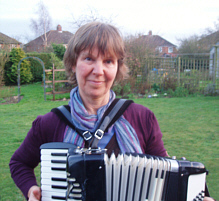
Heather is the daughter of Ken and Naomi Alexander and has written tunes to several of Ken's dances, now published in the book “Home Brew”. Perhaps her best-known tunes are those written for Ron Coxall's dances, including “Midnight Moorings” for his dance “Turn of the Tide”. In 2011 she published a book of “Heather's Tunes” which you can buy from her for £7.50: e-mail Heather at You must enable JavaScript to see this email address. or phone her on 01449 615816. It's also available from Genni and Darren Grainger at Folk Sales.
Sunday at Morningside Added 24-Jul-26
Format: Longways duple. Added 24-Jul-26Dance and Music by Robert E. Jamison
| A: | Ones cross and cast round one person to the middle of a line of four facing up. Lead up two waltz steps; fall back and bend the line. |
| B: | Circle left once around. Twos half figure eight down through the ones. |
| C: | Ones cross and cast up round one person to the middle of a line of four facing down. Lead down two waltz steps; fall back and bend the line. |
| D: | Join hands in a ring, set right and left smoothly (6 even steps); circle left half-way. Ones half figure eight up through the twos. |

Robert has “Balance the ring” at the start of D, but that comes from American contra and this is an English dance so I believe a smooth setting step (no bouncy-bouncy as you would in jig time) is more appropriate.
You can see many of Robert's dances at drive.google.com/drive/
Swirling Waters
Dance and Music: Colin Hume, 2009.Format: Longways duple improper — double progression.
| A1: | Right-hand star half-way; turn out (to the left). Left-hand star half-way; turn out (to the right). |
| A2: | Ladies cross right shoulder; men cross right shoulder. Circle left half-way; ones cast, twos lead up. [First progression] |
| B1: | Interlocking heys: ones lead down through new twos and cast up while twos move up and lead down, then ones lead up through original twos and cast down while twos move down and lead up. |
| B2: | Take ballroom hold and waltz round the new couple 1½ to finish facing the next couple. [Second progression] |
First called at my House Party weekend at The Paddocks Hotel in Symonds Yat, near Ross-on-Wye, Herefordshire, in November 2009. I didn't have a name for it, and Dick Hosking suggested this because the river Wye (which runs very close to the hotel) was in flood — the waters certainly were swirling.
Abnormality
Format: Longways duple improper. Dance: Danika and Emma Murray, 2003?.Music: 32 bar American jigs
Start in improper formation, give right hand to neighbour, first man and second lady turn half-way to a wave. Each turn of the dance starts like this
| A1: | Balance right and left, Rory O'More slide or twirl right. Balance left and right; slide or twirl left. |
| A2: | Neighbour gipsy right (4 steps); ones gipsy left (4 steps). Pass neighbour right shoulder (2 steps), twos gipsy left (4 steps), pass neighbour right shoulder (2 steps) to starting position with ones facing partner. |
| B1: | Ones balance and swing — end facing partner as at start. |
| B2: | Ones pass right shoulder into hey for four but when first man and second lady pass your partner the second time you progress (the “normal” direction, man down, lady up) and right-hand turn new neighbour half-way to a wave. |
There's a clue in the title: this is a very unusual contra! A2 is quicker than people realise, though there's recovery time in B1. The first man leaves the hey before the second lady, so he may have to wait for the new second lady to appear, but they must do their right-hand turn half-way before starting the next turn of the dance.
It might be a good idea to walk everybody through as both ones and twos.
I met the Murray sisters in June 2004 at Ann Arbor, Michigan where I was running an Advanced English Workshop followed by a Contra Dance, and they were amazingly good at both as well as being great fun. They asked me if I would like to see a contra they had written, so these four gorgeous girls demonstrated “Abnormality” while I struggled to understand what was going on — I couldn't even work out which were supposed to be men! They wrote out the instructions for me; I said it would baffle most contra dancers and they laughed and said yes it does.
Allison's Favorite
Format: Double longways improper. Dance: Colin Hume, 2024.Music: 32 bar American jigs (because of all that balancing)
| A1: | Lines of four forward and back. Left-hand people (of each couple) make a left-hand star: balance in and out; star half-way. |
| A2: | Meet the one diagonally across from you, balance and swing — finish on the usual side, facing into the set. |
| B1: | Right-hand people make a right-hand star: balance in and out; star half-way. Swing partner and face into the set. |
| B2: | Join hands in a ring of 8: go in to the middle and back (with suitable noises). Balance the ring; California twirl partner to face a new line. |
As usually happens in a double contra, you stay with the other couple in your own line but alternate ends.
For the partner swing, the left-hand people need to move forward and to the left as your partner approaches.
When you're out at the ends you can do the figure as a two-couple set. Just make sure that the final California twirl leaves you facing the approaching line of four.
Allison Jonjak wrote to the Contra Callers List:
My barn dance series has been doing well with an occasional contra dance added in, and progressions are working. I feel “safer” including contra style progressions as 4-face-4 dances, though, especially when I have a wide age range of dancers. I know “trail buddies” can help the kids point in the right direction each time.Coconut Cream Pie (contradb.com/dances/1548) is getting a lot of play lately, but I'd like to have a few more of that style in my deck. It would be nice to have a 4-face-4 both before and after the break, without it being literally the same dance.
Any simple favorites? Bonus points if they are a california twirl progression to feel “familiar”.
I waited a few days but saw no response (though I discovered later that a few people had responded off-list) so I decided to write one — going for the bonus points, naturally! And I'm using positional terminology rather than gendered.
Alterations Swing
Format: Longways Becket. Dance: Colin Hume, 2003.Music: 32 bar American reels
| A1: | Circle left ¾, pass through. Swing the next. [If you have reached the end of the set, swing your partner and change places — you are never out!] |
| A2: | Long lines forward and back. Swing the next, and finish facing this neighbour. |
| B1: | “Do Paso”: Turn neighbour by the left half-way, men cross right, turn partner right half-way, men cross left, turn neighbour left all the way. |
| B2: | Ladies allemande right 1½. Swing partner. |
First called at Chippenham Festival, May 2003, with Alterations providing their usual lively music.
Blackmore Gardens Contra
Format: Longways duple improper: Triple progression.Dance: Colin Hume, 2001. Music: 32 bar American reels
| A1: | Allemande left neighbour 1½. Ladies chain across. |
| A2: | Half promenade. On the right diagonal, right and left through (still with partner). Ends cross the set immediately. |
| B1: | On the left diagonal, ladies chain. Straight across, ladies allemande right 1¼ to a wave of ladies up and down the centre. |
| B2: | Balance the wave right and left; allemande left (the next lady) half-way. Star right with the next (men fall in behind your partners) one and a bit, and on to the next to start again. |
First danced in the Blackmore Gardens marquee at the Sidmouth Festival in 2001, where it proved much harder than I had anticipated — in fact a total disaster! There's too much going on, particularly a right diagonal move followed by a left diagonal move. And people just aren't quick enough to adjust when they reach the end of the set — which they do frequently since it's a triple progression!
Christmas Hornpipe
Source: Prompting: How to do it, 1890.Republished: Ralph Page Book of Contras, 1969.
You can borrow this book from archive.org/details/
Also known as Vinton's Hornpipe and that's the tune I've given.
Format: Longways duple proper (originally triple)
Actually the instructions at archive.org/details/
Music: Own tune (32-bar reel) or you might like to use Christmas carols
| A1: | First lady set to the second man; set to the next man (who won't be awake). Those three circle left. |
| A2: | First man similarly — same sleeping person every time! |
| B1: | Ones lead down the centre, turn alone. Dance back, cast round the twos. |
| B2: | With that same couple, four changes with hands. |
Usually when the caller says “Here's a fun dance” I sit down, because I know I'm going to hate it, but this one really is fun — even Renata thinks so! Because it's been converted from triple minor, the ones are also the threes of the next set above, and they have no idea that someone is setting to them. I encourage the active dancers to attract the other person's attention in whichever way they wish, and since it's the same sleeping person each time I suggest that they use increasingly dramatic measures! The position where everybody goes wrong is where they've reached the top of the set, been ones twice without any problem, and the third time there's someone above them trying to set to them. The men are so busy trying to tell their partner what to do that they are then caught out in the same way.
If you see it as a contra, you would have the twos face up and put an arm round the waist of the ones as they come up the set, to help them round, and you would call the four changes as a same-sex right and left through and back.
Colin's Back
Dance and Music: Colin Hume, 1985 Format: Longways duple improper (double progression)
| A: | Do-si-do your neighbour. Walk past, swing the next, finish with the lady on the right. (Neutrals at the ends swing your partner and face into the set — stay awake!) |
| B: | Circle left 1¼ and face your original partner up and down the room. Pass through to an ocean wave with the next pair; balance forward and back. (You meet the same person with your right hand every time.) |
| C: | Swing through (turn half by the right, men turn half by the left), boys run (men pass clockwise round the lady and take her by inside hand while the ladies move together slightly so that the men don't have to go so far), bend the line (turn as a couple ¼ to face the other pair). Lines forward and back. |
| D: | Half promenade, and curve round to face across the set to your original partner, who was one place further up or down the set. (Neutrals face in to the set with your partner — you still need to stay awake!) Make a left-hand star: balance in and out; star half-way and face the next couple (men turn out to right). |
Written in memory of my bad back at Sidmouth Festival in 1985. This is a difficult dance, not to be played too fast — think “Charleston” (or perhaps a more apt phrase is “laid back”). The three Western Square movements in a row will prove too much for some people, and anyone who switches off on reaching the end of the set will provoke a total disaster.
The Country of Marriage
Dance: Susan Kevra, 1992Music: Beaumont Rag or similar rags
Format: Longways Becket, single progression.
| A1: | Circle left ¾. Do-si-do neighbour to a wave. |
| A2: | Balance right and left; ladies quick allemande left all the way. Swing neighbour, finish facing across. |
| B1: | Right and left through. Men allemande right ¾ to meet the next man in a momentary wave of men; allemande left with him ¾ while ladies move to your left. |
| B2: | Balance and swing partner. |
Susan writes,
This dance was written for Bill Tomczak on our first wedding anniversary, which was celebrated upon Bill's return from a two week trip to Czechoslovakia in 1992. The theme of departure, separation and return are suggested in the dance's storyline, for those who seek meaningful symbolism in a contradance! After a bunch of wandering around, you finally find your partner for a swing. The dance takes its name from a poem by Wendell Berry.At the end, wait out on side in Becket formation, so the man can join in on the “zigzag chain”.
Double Swing Through
Format: Longways duple improper.Dance: Colin Hume, 1997. Music: 32 bar American jigs
| A1: | Do-si-do neighbour to a wave. Swing through (half a right-hand turn, middles half a left-hand turn — it's fast); balance the wave right and left. |
| A2: | Gipsy right partner. Swing. |
| B1: | Long lines forward and back. Ladies chain across. |
| B2: | Men allemande left half-way, give right to partner in a wave; swing through (home). Balance the wave; pass through to a new neighbour. |
Written as a lead-in to my most difficult square, “Triple Swing Through” (Squares with a Difference, Volume 2).
Greyhound to Harrisburg
Format: Longways duple improper.Dance: Colin Hume, 2006. Music: 32 bar American reels
| A1: | Do-si-do neighbour. Swing, and finish facing down in a line of four. |
| A2: | Go down the hall (6 steps), keep hands, twos turn back to back to face up while ones take hands behind them (2). Go up the hall (6). Twos duck and ones bring joined hands over the twos to form a four-leaf clover (2). |
| B1: | With a buzz (pivot) step, turn it round 1¼. Swing partner on the side. |
| B2: | Long lines forward and back. Circle left ¾, pass through. |
Written on a Greyhound bus going from Pittsburgh to Harrisburg in December 2006, and called at Harrisburg that afternoon. Based on Cary Ravitz' dance “The Squeaking Wheel”.
Hey Both Ways
Format: Double longways improper32 bar American jigs/reels
| A1: | Lines of 4 forward and back. With the opposite couple, right and left through. |
| A2: | Allemande left corner (for the ends it's your opposite) 1½ into a square. Side ladies pass right shoulder: hey across half-way. |
| B1: | Heads right and left through. Head ladies pass right shoulder: hey up and down half-way. |
| B2: | Original partner balance and swing — finish facing original direction but you've changed ends of the line. |
Written for the May Heydays Contra Competition 2023.
No Surprises
Format: Longways duple improper.Dance: Colin Hume, 1994. Music: 32 bar American jigs
| A1: | Allemande left neighbour 1½. Ladies chain across. |
| A2: | Ladies start a hey for four — keep going until you meet your partner back on that side. |
| B1: | Balance and swing partner. |
| B2: | Long lines forward and back. Circle left ¾ (home), pass through. |
| Instead of the circle and pass through you can use a ladies chain, which is an easier move but doesn't leave you facing your new neighbour. |
I was calling “The Dancers' Surprise” from the book Zesty Contras at the Beginners session at Cecil Sharp House, and discovered that if people aren't too sure of a reel of four (hey) they can't cope with one which has a surprise in it. I wrote this dance so that if the walkthrough ever went that badly again I would have a replacement on the other side of the card!
Pick 'n' Nick's Contra
Format: Longways duple improper. Dance: Kathryn & David Wright, 1990.Music: “Long John Silver” by Chris Dewhurst.
| A1: | Gipsy right neighbour. Swing neighbour. |
| A2: | Ladies chain across. Left-hand star. |
| B1: | With the next pair, right-hand star (leaving your partner). Partner left-hand turn to tidal waves with the men facing out. |
| B2: | Balance forward and back; ladies cross straight over to where the other man is, men loop left to where partner is (home) and give left to neighbour. Allemande left 1½ to progress. |
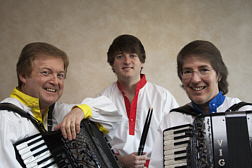
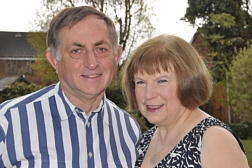
Kathryn and David Wright are well-known callers, dance writers and dance interpreters who have published several books of dances. All five of them live in Lichfield, Staffordshire.
Princeton's Silver Lining
Format: Longways duple improper. Dance and Music: Colin Hume, 2004.| A1: | Allemande right neighbour ¾, men allemande left half-way. Swing partner on the side. |
| A2: | Circle left. Gipsy right partner. |
| B1: | Turn away from partner to do a left-hand star in new fours (with shadow). In original fours, right-hand star. |
| B2: | Ladies chain across. Ladies pass right shoulder: half a hey. |
I put “a dance and tune to your specification” into the auction at Buffalo Gap in 2004, and Carol MacAdam bid the most for it. She wanted a contra dance to take back to Princeton celebrating 25 years of the dance community there. She wanted action outside the minor set, hands-across stars with one foursome going into stars with another foursome and then some people dropping out while others continued — and she wanted it to be accessible to not very good dancers! I said I assumed she also wanted a partner swing and a neighbour swing, and she said yes to that as well. I managed everything except the neighbour swing, and tried it out at the Show and Tell at the end of the week. Originally A2 started “Lines forward and back”, but people had real trouble remembering the gypsy, because after going forward and back they expected to do something with their opposite, so I've now changed it to “Circle left”.
The first tune I wrote for it was more of a rag, and a couple of bands said, “It's a good tune, but not for a contra”. So two years later I came up with a more suitable tune, and had the opportunity to present it while calling a mixed evening (contra, squares and English) in Princeton with Panjandrum playing.
Top Marks
Format: Longways Becket. Dance: Colin Hume, 2001.Music: 32 bar American reels.
| A1: | Long lines forward and back. Step forward to a wave in your foursome (give right to your opposite, ladies give left), and immediately spin the top (all right-hand turn half-way; middles left-hand turn ¾ while ends move round one place to meet the same person — make sure you touch hands in the new wave, so that everyone knows which way they're supposed to be facing). |
| A2: | Pass through, do-si-do the next (leaving neutrals who face in with the man on the left). Spin the top to a tidal wave. |
| B1: | Pass through; California twirl with partner. Ladies chain across. |
| B2: | On the right diagonal, ladies chain to shadow. Swing corner (original partner). |
First called at Sidmouth in 2001 as a lead-in to my square Topspin which also has two occurrences of the Modern Western Square Dance move “Spin the Top”. I find it works well to introduce a new figure in a contra, which tends to be more forgiving, before doing it in a square.
A Trip to Easthampstead
Dance and music: Ellen Taylor, 1984.Format: Longways duple improper.
| A1: | 1st woman cast, followed by her partner, anticlockwise round 2nd man, clockwise round 2nd woman, to finish in 2nd woman's place (twos moving up). |
| A2: | 2nd woman repeat. |
| B1: | Men back-to-back. Women back-to-back. |
| B2: | Neighbours two-hand turn 1½ to progress. Lead out to sides; change hands and lead back. |
| C1: | (4 bars): Partners back-to-back. |
| C2: | Partners two-hand turn. |
A Trip to Keswick
Dance: Dave Turner, Hartburn, Stockton-on-Tees, 1986. Music: 32-bar American reelsFrom the book Dance Search.
Format: Longways Becket.
| A1: | Do-si-do corner (shadow). Do-si-do partner. |
| A2: | Circle left. Ladies chain across. |
| B1: | Right and left through. Square through two hands, pull by right the next. [If you reach the end of the set, the pull by is with your partner across the set.] |
| B2: | Swing the next. Ladies chain across to partner. |
Composed for the Stockton EFDSS weekend in Keswick, 1986.
Triple Chocolate
Format: Longways duple, twos improper.Dance: Colin Hume, 2001. Music: 32 bar American reels.
Join up in 4 couple sets. Ones and twos are shadows, so are threes and fours.
| A1: | Ends with partner, middles with neighbour, balance and swing to form a square set. |
| A2: | In to the middle and back. Head ladies chain. |
| B1: | All four ladies chain. Side ladies chain. |
| B2: | Heads pass through; sides pass through — keep with your shadow couple, face your partner and join up in new lines of four. Lines forward and back. |
| Shadows have alternated, so the original ones are now below the twos. | |
Based on “Double Chocolate” by Jim Kitch. from his book “To Live is to Dance”, 1995, but I changed B2 so that the shadows alternated roles.
Triple Delight
Format: Longways duple improper.Dance: Colin Hume, 2009. Music: 32 bar American reels.
Take hands four. You stay with this couple up or down the set, but alternate positions. Now take hands in side lines of four.
| A1: | Side lines of four go forward; middles fall back to square. All four ladies chain across. |
| A2: | Men star left ¾, swing this lady (corner). |
| B1: | Ladies star left ¾, swing the one they chained to. |
| B2: | (Current) sides pass through, separate, go round one; heads pass through to meet your shadow couple. Circle left with them and join up in new lines of four. |
| Shadows have alternated, so the original ones are now below the twos. | |
Based on “Double Delight” by Jim Kitch. from his book “To Live is to Dance”, 1995, but I changed B2 so that the shadows alternated roles.
Would you do it for $20? Added 26-Jun-25
Format: Longways duple Proper. Added 26-Jun-25Dance: Robert Cromartie, 2017? Music: 32 bar American jigs/reels
| A1: | Balance the ring; Petronella. Same again. [All progressed and improper.] |
| A2: | Ones right-hand balance; box the gnat, [ones now proper below twos improper], ones lead contra corners (partner right, first corner left, partner right) — corners are same sex as you — until you meet second corner — don't touch! |
| B1: | Ones pass second corner left shoulder: Almost a complete hey on the second diagonal, until the ends are home and the ones meet for the second time. |
| B2: | Ones balance and swing, end facing down. [All improper] |
On alternating turns the twos are in charge. All start Improper.
| A1: | Balance the ring; Petronella. Same again. [All progressed and proper.] |
| A2: | Twos right-hand balance; box the gnat, [twos now improper above ones proper], twos lead contra corners (partner right, first corner left, partner right) until you face second corner — don't touch! |
| B1: | Twos pass second corner left shoulder: Almost a complete hey on the second diagonal, until the ends are home and the twos meet for the second time. |
| B2: | Twos balance and swing, end facing up. [All proper.] |
Women in Charge
Format: Longways duple improper.Dance: Colin Hume, 1997. Music: 32 bar American reels
| A1: | Allemande right neighbour 1¼. Women allemande left 1, 1½ or 2 as they choose. |
| A2: | Women balance and swing the man they have chosen this time. |
| B1: | Women chain across. Circle left ¾, pass through. |
| B2: | Do-si-do the next. Women turn round, allemande left once around (with the same woman as before) and move on to next neighbour — or even allemande 1½ to change partners if they choose. |

And it caused chaos at Southam for me in 2019! I've now decided it's best to have the women allemande left just once in B2 and make sure they end facing their new neighbour. Later you can tell them that if they wish they can change partners, so long as they realise they will now be looking for their new neighbour in the opposite direction. I also found that although I said “Women allemande left” some of them thought I meant “Women allemande left with this neighbour”!
Working Man's Reel
Format: Longways duple improper.Dance: Colin Hume, 1992. Music: 32 bar American reels.
| A1: | Do-si-do neighbour. Star through, pass through (across), wheel around (rapidly). |
| A2: | Ladies chain across and back. |
| B1: | Left-hand star. Ladies turn out to your right, swing neighbour. |
| B2: | Do-si-do partner. Star through; pass through (up and down). |
Having only done ten days work in 1992 (computer programming and lecturing that is, not the Folk Dance stuff which certainly wouldn't make me a living) and six so far in 1993, it was wonderful to get two contracts almost together! I was pleased with the dance and sent it to the internet discussion group rec.folk-dancing, saying that it would probably not find favour with contra dancers in the States because it didn't have a partner swing. Dan Pearl replied, “I suspect this one won't be popular in New England, at least, because of the presence of Star Thru's. That movement, along with Flutterwheel, are figures that are found in UK-grown 'American' dances, but are not really found in American contras (except for those composed by the modern Western square dance-influenced composers).” There was some discussion on the lines of “Would we really be so prejudiced that we'd reject a good dance because it had a MWSD figure in it?” and the conclusion seemed to be, “Yes we would”!
Albarony The Ale Wife and her Barrel L'Allegrante
All Saints
Format: Longways duple.Dance: David Ashworth, 1975. Music: Chestnut (Playford)
| A1: | First corners right-hand turn while second corners walk straight across the set and round to the left to finish in each other's place. |
| A2: | Second corners left-hand turn, others walk, etc. All are now progressed and improper. |
| B1: | Fall back a double with neighbour; lead forward. Pass through with partner, turn right, single file half-way round, finishing in a line facing up, ones on the ends (first lady on the left). |
| B2: | Lead up a double; fall back, drawing the ones in. Ones cast, twos lead up; all two-hand turn half-way. |
David Ashworth lives in Essex and has recently returned to dancing after a break of a number of years. Don't be misled by other versions — this is how he wrote it. It's “Ashworth” not “Ashwell”, and there's no “Day” in the title. He wrote the dance on 1st November, All Saints' Day, and the title was also apt as the school he was at was All Saints'. This is the only dance he has written.
As to the music, if you look at Playford's original you will see that there's a note missing in the last bar but two. Cecil Sharp always tried to do the minimum necessary change so he lengthened the final note, but comparison with the previous bar produces a more likely correction by adding the missing note.
Amy
Format: Longways duple. Dance and Music: Colin Hume, 2006 | A: | All step right and honour partner; turn single left. Step left and honour partner; cross right with partner. |
| B: | Right-hand star. First lady and second man leading, others following same-sex neighbour, loop left and move across the set so that the leaders have changed places and the followers have gone in a loop and got nowhere, all finishing with left shoulder to partner. |
| C: | With right-hand neighbour (semi-permanent shadow) gipsy right. With partner gipsy left 1¼ until first man and second lady are facing each other. |
| D: | They (the new leaders) pass right shoulder into a straight hey across the set: each person does two changes and then loops right — the leaders will want to loop left but they mustn't. Circle left ¾. |
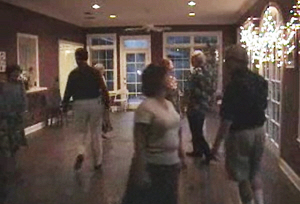
A week later I called it at a potluck at Charlie Dyer's house in Jacksonville, Florida, with Carole Wetzel playing piano. Click the image on the left to watch Charlie's recording of one turn of the dance — you may notice me nearly going wrong at one point!
The final move confuses people — particularly when they change numbers. Once people “get” the move it flows perfectly well. Make sure that when you make the circle the two men are together and the two ladies are together. Gene Murrow's suggested wording is,
“The first corner people meet for what feels like 3 changes of a hey across the dance, with a twist. Those people do only two changes — pass right, next person left, then, instead of looping left as you would want, you loop right into a circle. The others carry on normally, joining the circle…”People are also confused by the “shadow” business. You have the same shadow until one of you reaches the end of the set. At that point things get confused — you find two men gipsying at the top and two women gipsying at the bottom, and the neutral couples panic and try to change sides, which doesn't help because there are actually three men in the top foursome! Then as you go back the other way you have another shadow — it's the partner of your partner's previous shadow, if that's any help!
Black Robin
Dance: David Stephens of Ramsgate, Kent. Music: A Simons, 1986.From the book Dance Search.
Format: Longways duple minor.
| A: | First man second lady right-hand turn half-way; all turn single right. Circle left half-way; set right and left to partner. |
| B: | First lady second man right-hand turn half-way; all turn single right. Circle left half-way; set right and left to partner. [Progressed and improper] |
| C: | Fall back a double with neighbour; lead forward, ones right-hand turn half-way while twos cross right and stay facing out. Twos cast down and lead up while ones lead up and cast down. |
| D: | All back-to-back partner. All left-hand turn partner. |
Bobbing Joe The Bonny Breastknot Bonny Cate Bulock's Hornpipe
The Bribe
Format: Longways duple minor.
Dance and Music: Colin Hume, 2003, revised 2007.
| A1: | (12 bars): First corners right-hand turn half-way; all right-hand star half-way. While second corners continue the turn home and on into neighbour's place, first corners cast out of the star, pass your same-sex neighbour left shoulder to face each other across the set: pass right shoulder into half a hey across while second corners cast out and follow neighbour, all finishing in partner's place (6 bars); all set to partner. |
| A2: | Second corners (now in first corners' place) the same. |
| B: | (12 bars) All back-to-back partner. Cross right, turn right; circle left half-way. Two-hand turn partner. |

I tried to play the tune of “De'il take the Warr” on the piano, and twice I reversed the third and fourth notes and went back to the tonic for bar 2. After the second attempt I thought “That sounds interesting”, and the rest of the A-music appeared. It obviously didn't want to finish at the end of 8 bars, so I gave it 12, and wrote a matching B-music.
First danced at the Yuletide Cotillion in New York City, December 2003, with Bare Necessities playing the music. People struggled with the dance, and I called it a few times since then with mixed results. So in 2007 I produced an easier version and that's the one given here. I recommend that you demonstrate the whole dance.
Calliope
Format: Longways duple minor.Dance and Music: Colin Hume, 2016 (dance revised 2018 and 2019)
| A1: | (12 bars): First man cast, followed by partner, twos lead up and cast down (6 steps) into a full hey for three across, ones acting as a unit and starting by passing the second lady right shoulder, then ones continue across the set to finish improper below the twos who are proper (18 steps). |
| A2: | Second man cast, followed by partner, ones lead up and cast down into a full hey for three across, twos acting as a unit to pass the first man right shoulder, finishing twos below ones, all improper. |
| B1: | (12 bars): Twos lead up 2 steps, pick up the ones and all lead up 4 steps; all fall back for 4, twos fall back for 2 to bend the line into a circle. Circle left half-way; ones cross and cast up, twos lead down and turn single away (man right, lady left), finishing ones improper above twos proper. |
| B2: | Ones lead down 2 steps, pick up the twos, lead down 4; fall back, bend the line. Circle left half-way; twos Hole-in-the-Wall cross. |
In English, epic poetry is written in iambic pentameters. Some common examples are:
Elegy written in a Country Churchyard: Thomas Gray, 1750
The Curfew tolls the knell of parting day,
The lowing herd wind slowly o'er the lea,
The ploughman homeward plods his weary way,
And leaves the world to darkness and to me. …
On His Blindness: John Milton, 1673
When I consider how my light is spent
Ere half my days in this dark world and wide,
And that one talent which is death to hide
Lodg'd with me useless, though my soul more bent
To serve therewith my Maker, and present
My true account, lest he returning chide; …
and lots and lots of Shakespeare…
Now is the winter of our discontent
Made glorious summer by this son of York…Shall I compare thee to a summer's day?
Thou art more lovely and more temperate:
Rough winds do shake the darling buds of May,
And summer's lease hath all too short a date…
and The Art of Dancing: Soames Jenkins, 1729
But let not outward charms your judgement sway,
Your reason rather than your eyes obey;
And in the dance, as in the marriage noose,
Rather for merit than for beauty choose…
That means that each phrase has 10 beats, and I added a pause of 2 beats to make 12 beats or 6 walking steps. I called the first version of the dance in Boston and it was far too complicated. I simplified it and called it in Rochester a few days later — it was still too complicated. On my return to England I tried out versions 3 and 4 but still wasn't happy with the way the dance flowed. Back in the States in 2019 I tried out version 5 in Westchester with The Calliope Trio (unrelated to Amy's band) and for the first time managed to stop calling for the last few turns of the dance, but Paul Ross said there was still one awkward move — and he was right! This is version 6, first danced with real style in Amherst, Massachusetts with Calliope in sensational form.
Dancing in Amherst was Graham Christian, who told me that what I was saying about epic poetry being in iambic pentameters wasn't the full story. He later elaborated:
The prevailing metrical form for the lines of epic poetry in the Classical tradition — which would be pertinent to a Muse like Calliope — is the Dactylic hexameter. In contrast to our own dear old iambic pentameter, it's in six rather than five chunks. Also, rather than our fairly predictable and sometimes drum-like ta TA, the hexameter is arguably trickier, because it's a TA ta ta, and that metrical foot is varied fairly often by skilled poets; also, each line concludes with a TA ta or TA TA. And — harder to discern in English — Classical verse was measured by length (quantity) rather than our somewhat more obvious stress (accent).There are two epic poems of note in English: Spenser's The Faerie Queene and Milton's Paradise Lost. The latter is in iambic pentameter, but unrhymed; the former is in a complex stanza of Spenser's own invention. How many epic poems in English there are depends upon the latitude of one's definition. Heroic action in exalted style, mortal and heavenly characters, epithets, begins in medias res? Milton and Spenser for certain. If one's definition is looser, all sorts of candidates appear — Byron's Don Juan, E. Barrett Browning's Aurora Leigh, Longfellow's Evangeline, Pound's Cantos, and on and on.
There's plenty of time for the moves in the A-music, so the dancers need to be expansive in the heys to avoid finishing before the music does. In the B part dancers need to be aware of the six beats: there's a temptation for the twos to grab the ones immediately, lead up for four steps and then not know what to do with the extra two beats. If I had made the dance totally symmetric and ended B2 with the twos crossing and casting, it would never progress. A Hole-in-the Wall cross seemed the minimum necessary change, and means the ones are ready to start the cast at the start of the next turn of the dance. Throughout the rewriting process I didn't need to make any changes to the tune, which pleased the band as they liked it the way it was. It's in Mixolydian mode.
Amy Cann is probably best known for her American reel Catharsis. I also particularly like her beautiful waltz House by the Lake.
Carshalton Grove
Format: Longways duple minor. Dance and Music: Ellen Taylor, 1977| A1: | 1st couple right-hand turn. Cast to 2nd place, 2's moving up on last 4 beats. |
| A2: | 2nd couple the same. |
| B1: | 1st couple whole figure eight down through 2nd couple (12 steps) — on last 4 beats 1st couple lead down to 2nd place while 2nd couple cast up. |
| B2: | 2nd couple two-hand turn. Lead down between 1st couple and cast back to progressed place. |
Colin's Tambourine
Format: Longways duple minor. Dance and Music: Colin Hume, 2001. | A1: | First corners cast left shoulder, behind neighbour, gipsy left in the middle and fall back into each other's place. |
| A2: | Second corners cast right shoulder, behind partner, gipsy right in the middle and fall back into each other's place. |
| B1: | Ones cast up, twos lead down and follow, ones lead down to the middle of a line of four facing down. Lead down a double, fall back, bend the line. |
| B2: | Ones cast, twos lead up and follow, ones lead up to the middle of a line of four facing up. Lead up a double, fall back, stay in the line. |
| C: | Ones face partner: two changes of a straight hey; ones cast, twos do another change [progressed]. All two-hand turn partner. |
The first lady will want to loop up at the end of the straight hey, but she has to loop down! Just remember that you're aiming for your progressed places.
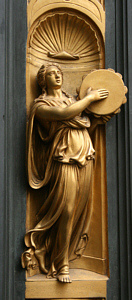
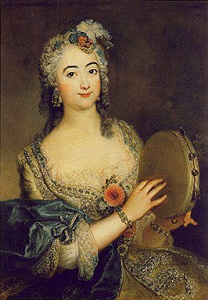
If you need further convincing of the tambourine's respectability, the other picture is a gold tambourine player from the “Gates of Paradise” of the Florence Baptistry created between 1401 and 1422. See en.
For a later dance of mine dedicated to this fine and underrated instrument, see La Tambourine
The Comical Fellow The Coronation Day
Country Courtship
John Young, Dancing Master Volume 3, c. 1727.Format: Longways duple — double progression
The first Couple cast off, and half Figure with the third Couple, then cross over to the top and cast off . The other Couple do the same : Then the first Man change places with the second Woman and second Man with the first Woman, and Hands all four half round and cast off . Then back to back and Right and Left quite round :
| A1: | Ones cast (twos lead up), half figure eight down through new twos (through an imaginary couple at the bottom), half figure eight up through twos (all danced with a skip-change step). |
| A2: | Twos the same, all finishing home. |
| B1: | First corners cross; second corners cross. Circle left half-way; ones cast, twos lead up. |
| B2: | All back-to-back partner. With the next couple three changes with hands (skip or skip-change step). |
This one does not go down well in the States because the first half really needs to be danced — in other words done with a skip or (preferably) skip-change step — there are three moves in the time usually allotted to two. It was originally triple minor, with the half figure eights down through the threes (who did nothing), and I learnt it as a 3-couple set dance, but I prefer it as duple minor even though it means you have further to go in the half figure eights.
The Countryman's Hat
Dance: Irene Crew. Music: “Bracken Rigg” by Jack Armstrong.
Format: Longways duple
| A1: | All right-hand turn partner half-way; right-hand star all the way (4 bars); ones cast, twos lead up. |
| A2: | Half double figure eight: twos (at the top) cast and cross coming up while ones half figure eight up, all finishing proper in progressed place. Men left-hand turn, ladies right-hand turn. |
| B1: | Ones pass partner right shoulder to start a diagonal reel with the second man (who casts into it from the turn). |
| B2: | Ones pass partner left shoulder to start a diagonal reel with the second lady. |
This is a real winner: it flows beautifully from one movement to the next and gives the dancers great opportunities to work together as a team and fit the movements to the music. I can imagine it working well as a Scottish dance too, and it is set to a Scottish reel which might encourage people to dance it rather than walk it. But people find it disorientating. You start the double figure eight progressed and improper, which often fools people — and there's no recovery time before that. Also people want to finish each movement, stop and face their partner, which isn't going to help the flow one bit. Trust the dance! And the second man often just can't cope with casting into the reel, which leaves the ones wondering who they're supposed to be reeling with!
You need to be aware that the progression happens half-way through the dance; the diagonal reels both finish where they started.
First published in English Dance and Song, Autumn 1999. I was calling at the County Club in Exeter in 1999 and started with “The Countryman's Hat” by Irene Crew. People pointed out that Irene was dancing at the head of one of the sets, and during the tea break I met and talked to her and several other ladies about the good old days of the Society. The County Club (officially the Devon District Playford Club) consists mainly of older ladies who enjoy their dancing, prefer Playford-style repertoire, and are concerned that there should be teaching during the session rather than just a string of dances. They meet once a month on a Sunday afternoon and have live music — on the three occasions that I've called there, the very live music of Gwynn George on piano. Later I contacted Irene to talk about dances and dancing. Irene started dancing when she was 14, and when I met her she was 83. She gained the EFDSS Silver Badge and accompanying certificate, and knew most of the EFDSS staff; she remembers Cecil Sharp House being bombed during the second world war and then rebuilt. She describes herself as “Folk Dance mad”! She used to call dances, but she prefers to dance traditional and Playford dances in an environment where the dancers know the dances and a caller is not needed; she feels dancers these days are too lazy to use their brains. The Society was very different in her early days. There were not so many men until Princess Elizabeth joined the square dance craze in the 1950's and younger people came in. Morris dancing used to be part of the Society; now it is run by different organisations. And dances in those days had a song spot — usually unaccompanied.
Irene has written a number of dances, but has never found the time to publish them, so here on my website are two I've picked up over the years — the other is Barbara Walton's Delight. This was written for a dancing friend who was planning to retire from school early but had a massive heart attack around 1990 and died before that could happen. The Countryman's Hat was written while she and Barbara were on one of their trips to the Scilly Isles. They became drowsy; Barbara went to sleep and Irene says the whole dance just came to her. She has no idea why she chose the title.
Crosby Square The Cuckoo Damme Dance for Ever
Deck the Hall
Format: Longways duple minor. Dance: Ellen Taylor, 1985. Music: Traditional Welsh.| A1: | Right-hand star. Left-hand star. |
| B1: | 1st couple cross and cast into 2nd place, 2nd couple moving up. 1st couple half figure 8 up through 2nd couple, finishing proper in the middle of a line of four facing up. |
| A2: | Lead up a double and back. 2nd couple gate 1st couple round to progressed place. |
| B2: | 1st couple lead down through the couple below and cast back. All two-hand turn. |
Devonshire House The Devil's Dream Dick's Maggot
Ding Dong Merrily
Format: Longways Becket (or short sets if preferred)Dance and C-music: Jill Lawrence, 1979
| A1: | (4 bars): Move forward 3 steps to meet opposite, clapping both hands with opposite on the fourth beat; fall back to place. |
| A2: | Back-to-back partner, clapping both hands with the one you meet on the fourth beat — at end of set clap own hands. |
| B1: | Ballroom hold partner: gallop across with opposite couple, men passing back to back, 4 slips, and back on the other side. Ladies chain across. |
| B2: | Promenade across. Men change places left shoulder; all set to partner. |
| C: | Top couple on men's side gallop down to bottom as bottom couple on women's side gallop up — stay on own side — the others move left, clapping as they go, and all swing partners. |
Ding Dong Merrily is a dance I was asked to make up for Christmas set to a Christmas carol.
Diversions
Format: Longways duple minor. Dance and Music: Ellen Taylor, 1989.| A1: | 1st corners set moving forward; fall back. Start a gypsy right but then make a diversion behind neighbour back to place. |
| A2: | 2nd corners the same, but passing left shoulder. |
| B1: | Half poussette, second man pushing. Set; turn single. |
| B2: | Double figure 8: 1st couple cross moving up, cast down and repeat while 2nd couple cast down, cross up and repeat. |
Elizabeth
Format: Longways duple minor. Dance and Music: Colin Hume, 1991. Note: The tune is in 3-time.
| A: | Ones set; two-hand turn half-way. All set to neighbour; two-hand turn half-way. |
| B: | Back-to-back with partner. Circle left half-way; come in close to partner, then fall back with neighbour. |
| C: | Ladies right-hand turn half-way, left-hand turn partner all the way. Ladies right-hand turn half-way, left-hand turn opposite, all finishing back in the longways set where they started the movement. |
| [I hesitate to call this an open ladies chain, because thinking of it that way means that even when the men are not doing a courtesy turn they act as if they wish they were, and walk backwards!] | |
| D: | Ones cross, go below the twos; twos half figure eight up. Ones half figure eight up; twos lead up. (These movements overlap, and I suggest that you walk them through separately for the ones and then the twos. In effect the half figure eights are through a non-existent couple.) |
First performed at Elizabeth Elton's 75th Birthday Dance: Cecil Sharp House, 27th April 1991, with The Rampions (then called Sussex Rampion) playing.
First published in “Dances with a Difference, Volume 4” in 1996, where I wrote the following:
My first contact with Elizabeth was when she phoned me to say that she was over seventy and was she too old to come to “Beginners” — the class I helped to run at Cecil Sharp House? Of course not, I said, so she turned up — full of life and ready to join in everything. When we ran a twelve-hour dance marathon she was one of the few who danced every dance, including the final polka. She liked the energetic dances — she would polka with me until I was worn out, then move on to someone else — but was also very taken by the beauty of the slower Playford-style dances, so I just had to write this one for her.I haven't seen Elizabeth for some time, but I'm told she's bought a computer and is busy writing her memoirs; I know they will make fascinating reading.
Notes to musicians:
Although the tune is in 3:4 time I did not intend it to be a waltz; please don't take it too fast. Of course, you're welcome to play it as a waltz for a different dance or a free waltz and it has now been published in The Waltz Book III, collected and edited by Bill Matthiesen. Some musicians ask me very cautiously if it's all right to play one of my tunes, and I always say: “Of course, that's why I publish them”.
Elderberry Bubblegum
Format: Longways duple minor.Dance: Colin Hume, 2011. Music: Peter Jenkins, 2011.
Each sentence is 2 bars of 5-time (10 steps).
| A: | Ones cross, cast, cross again to the end of a line of four facing up. Lead up 5 steps; ones gate the twos up and round to finish back in the longways set but further up the hall. |
| Twos cross, cast up, cross again to the end of a line of four facing down. Lead down 5 steps; twos gate the ones down and round to finish in home position. | |
| B: | Three-quarter double figure eight: ones cross down, cast up, cross down again and turn out while twos cast up, cross down, cast up again, to finish with the twos improper above and the ones proper below. Symmetrical back-to-back with neighbour, started by the twos leading down and the ones moving up the outside. |
| Twos half figure eight down through the ones while ones move up the outside and lead down the middle. With new neighbours, circle left. |
First performed at The Southam Gathering in August 2011 with Deo Volente playing the music and emphasising the first beat of each bar; you could feel the concentration from dancers, band and caller but it seemed to go well. Click the image to see it performed at my House Party Weekend.
Folkus Pocus
Format: Longways duple minor.Dance and Music: Colin Hume, 2005. Note: The music is in 3-time.
| A1: | Right-hand star half-way (3 steps); turn single left (3 steps). First corners left shoulder back-to-back (6 steps). |
| A2: | Left-hand star half-way; turn single right. Second corners right shoulder back-to-back. |
| B: | Face neighbour: three changes with hands (3 steps for each), then pass next (previous) neighbour left shoulder to face yet another neighbour. Three changes with hands, then pass next neighbour left shoulder to face original neighbour in home place. |
| C: | First corners Hole-in-the-Wall cross: 3 steps to cross and face, clap both hands with opposite on beat 4, fall back on beats 5 and 6; second corners as much. Partners as much; two-hand turn partner. |
When you're walking this dance through, you need to explain the end effects very clearly!
- If you reach the end of the set during a turn of the dance, do one change with your partner while the others are doing three changes, and face into the set: you'll rapidly be in again. It's Rule 1 of End-effects — if there's no neighbour, treat your partner as a neighbour.
- If you're out at the start of a turn you need to change sides with your partner (so the man is in the ladies' line) because the moving couples will be improper when they come to you for the three changes so you should be too. In fact this is the same as the previous rule: while the other couples are doing three changes, you do one change. After the next three changes you'll be out again and back to your proper side. If you forget to do this, the moving dancers may be surprised to meet someone of the same sex but they'll get over it. The vital thing is to be back on your own side when you come in at the start of the next turn of the dance. My thanks for Gene Murrow for getting me clear on this.
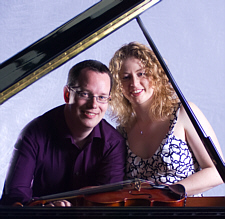 Written for Dan and Caroline Hollingshurst, who were the band for almost all of my Wednesday Workshops for two and a half years at Cecil Sharp House. When they decided to move up to Staffordshire I wanted to write them a tune which would suit their style (though indeed they have many styles), and I knew how well they played Dave Wiesler's tune for Gary Roodman's dance “Mary K”, so I took that as a model. I then got worried and sent a copy to Dave with a note: “I know they say that imitation is the sincerest form of flattery, but please tell me whether you think this is too close to your tune for Mary K.”
He wrote back, “Parts are surely reminiscent of Mary K, but then parts of Mary K are reminiscent of Hambleton's Round O. I think we all borrow and imitate. Nice tune, and no it's not too close at all.”
Find out more about Dan and Caroline at web.archive.
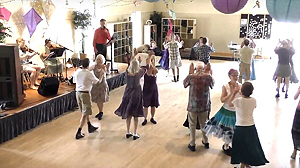
Click the image on the right to see it being danced at Ann Arbor, Michigan in 2016 — and they were doing pretty well!
This is a workshop dance and it's unlikely a band are going to record it, so click and then click “Play MP3” (NOT “Play MIDI”) and there should be a way to download the MP3 file to your hard disk, depending on how your browser is set up. There's an Intro of 3 potatoes, the tune 9 times through, and a final chord.
Friends and Neighbours
Format: Longways duple minor improperDance and Music: Jill Lawrence, Dances for Gloucestershire, 1973
| A1: | Give two hands to neighbour: men push 4 steps until alongside another two; face these new friends, those on the ladies side (first man and second lady) arch and cross over (imagine someone at the ends and still cross over). Men pull until opposite partner; ladies side arch (first lady, second man), cross over. |
| A2: | Men pull again; ladies side arch. Men push; ladies' side arch. |
| B1: | Set to neighbour; pass by. Two-hand turn partner. |
| B2: | Ones lead up through the twos; cast to progressed place. Twos lead down through the ones; cast up. |
Jill recommends that when you're neutral you don't try and join in the poussettes — just remember to cross over since the dance is improper.
Foxhunter's Jig
Format: Longways duple minor.Dance: Colin Hume, 2009. Tune: Traditional Irish (slip-jig).
Each line is four bars of slip-jig: 12 steps.

| A1: | First corners set: three even steps each way, no bounce, emphasise the first step. Two-hand turn (6 steps). |
| A2: | Second corners set. Two-hand turn. |
| B1: | All single file clockwise half-way. Move in to the centre; turn out to your left, clapping on the first beat of the bar. |
| B2: | Single file anti-clockwise half-way. Move in; turn out to your right, clapping on the first beat. |
| C1: | First corners cross right; second corners cross right. Fall back three steps with neighbour; lead forward. |
| C2: | All that again, to end in a line of four facing down with the ones in the middle. |
| D1: | Lead down, then turn towards neighbour to face up (6 steps). Lead up and bend the line — twos move in to progressed places. |
| D2: | Four changes with hands. |
I was calling for The Round, the Cambridge University Dance Group, and because this was before I formed my own band I wanted to use mainly tunes from the Big Round Band's standard repertoire, so I wrote this dance in 18th century style to fit the traditional Irish slip-jig.
From Aberdeen The Gothic Dance Half Hannikin Her Killing Eyes
Hands Across the Water
Format: Longways duple minor.Dance and Music: Colin Hume, 2014.
| A1: | Ones cross and cast; twos lead up. Pass the ocean; set in a wave. |
| A2: | Right-hand turn neighbour 1¼ (so the twos finish facing the men's wall). Second lady followed by partner go up outside first man and move across to finish proper; ones lead down. |
| B1: | First corner positions (second man and first lady) cross; the others cross and stay facing out. Lead neighbour away; turn in and lead back. |
| B2: | Partners back-to-back. Two slow changes with hands. |
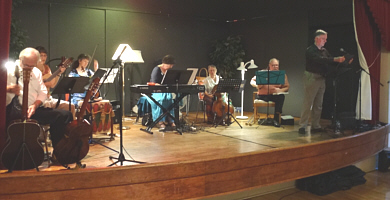 Written and called at the “Hands Across the Water” weekend in Victoria, British Columbia, and dedicated to Rosemary Lach, Ann Schau and The Dancehall Players.
I wanted it to be a surprise for all concerned, and it was done in rather a rush! I finished writing the tune on the Saturday evening (with Rosemary waiting for me to leave the house) so that I could give it to Ann (with a fake title) at the dance that evening and she could print out copies for the rest of the band. That night after calling the dance and socialising I finished writing the dance at half past midnight, so it was actually finished on the Sunday morning and called later that morning in the final session. It's the first time I've presented a new dance without ever having heard the tune and chords, but it all seemed to work! The Dancehall Players provided fabulous music all weekend and the dancers danced with considerable style, otherwise I wouldn't have finished with two slow changes — many dancers would rush that and it would be an unsatisfactory conclusion.
“Pass the ocean” is a figure from Modern Western Square Dancing. It's now used in a number of modern contras, but choreographers and callers have renamed it “Pass through to an ocean wave” to conceal its origins. My view is that a good figure is a good figure and I don't worry where it comes from. In this case you're all facing across to your partner. You pass through right shoulder, but the two ladies give left hands as they meet which means they will turn each other slightly and the men having gone further across then turn to their right to give right hand to their neighbour in a wave across the set. All that in four steps, but it's an easy figure once you've got it. The symbolism is that the wave represents water, it's across the hall, and you all take hands — Hands Across the Water!
His Royal Highness The Prince of Wales' Favourite
Format: Longways duple minor.Dance: 1800. Music: Charles Metralcourt
This interpretation appeared in a leaflet by Audrey Town in 1981, and since I believe it's out of print and I've been unable to contact Audrey I'm republishing it here. The leaflet reads:
This dance has been taken from a collection entitled 'Twenty-four country dances with proper directions to each dance as they are performed at Court, Bath and all public Assemblies humbly dedicated to His Royal Highness The Prince of Wales ~ Composed by Charles Metralcourt, Dancing Master,' dated 1800.The Prince of Wales of that time is perhaps better known as “The Prince Regent,” who later became George IV. The title of the dance is a matter for speculation. It was in 1800 that Mrs Fitzherbert, with whom George had gone through a form of marriage (she twice-widowed and a Roman Catholic) in 1785, returned to London after an estrangement of six years, during which time he had disastrously married his cousin Princess Caroline of Brunswick. On her return Maria Fitzherbert held a celebration for four hundred guests which lasted for fifteen hours. Their relationship continued intermittently until 1811.
Maybe the event in 1800 led to the production of the dance, who knows. Whatever, putting the past behind us, it is a dance worthy of recovery and what more appropriate time than now to revive it.
Sincere thanks are extended to Mr Stanley Hutchinson for his musical arrangement.
This dance was originally a triple minor in which the 3cu were slightly involved in the B2 movement. The adaptation has resulted in all the dancers being involved in this movement, neutral couples never being completely neutral.
© M.A.Town March 1981
I don't know which collection the dance appeared in, or why 1981 was an appropriate time to revive it, but here is my wording of Audrey's interpretation.
| A1: | Ones hold inside hands: step and honour second lady right and left. Circle 3 to the left. |
| A2: | Same with second man. |
| B1: | Ones lead down. Lead back, cast to progressed place. |
| B2: | All on the right diagonal right-hand turn. On the left diagonal left-hand turn. |
| C1: | In original fours, whole poussette: first man push to start. |
| C2: | In same fours, four changes with hands. |
| I've given two versions of the music: a melody line version with my chords, and Stanley Hutchinson's piano version: in both I have changed the time signature from 2/4 to 4/4. | |
| If you'd prefer, you can download a copy of the two sides of Audrey's original leaflet Here and Here | |
Hobb's Wedding Hole in the Wall
The Honeymoon
Format: Longways duple minor.Dance and Music: Preston — 24 Country Dances for the year 1806
| A1: | Set twice. Right-hand star. |
| A2: | Set twice. Left-hand star. |
| B1: | Ones lead down the middle, turn in, dance back, cast, twos lead up. |
| B2: | Four changes with hands. |
Jane Austen's niece Fanny Austen recorded a family ball in her diary, Friday 26th December 1806: …Edward and I opened the ball with the Honeymoon
. The setting has been added because the stars would not fill up the music allocated to them, and opinions vary on whether the ones lead up to the top and cast or whether they lead up to second place as the twos move up. An easy dance for a 14-year-old to lead, and the Jane Austen connection makes this a winner for a Ball where the attendees are more interested in pretending to be Elizabeth Bennett or Emma Woodhouse than knowing anything about dancing!
Inklings Romp
Format: Longways duple minor.Dance: Renée Camus, 2018. Music: Dave Wiesler, 2015.
Note: The tune is a slip-jig, so there are three steps to the bar.
| A: | Ones set; half gipsy right and turn single left. All set to the centre; circle right half-way, turn single right (cast out of the circle). |
| B1: | Gipsy right partner; gipsy left neighbour. Men pass right shoulder into a straight hey across the set just over half-way to meet partner. |
| B2: | Men push: half poussette; cloverleaf turn single away from neighbour. Two changes with hands; two-hand turn partner — ones once, twos ½ (or 1½ if you're quick). |

Renée Camus is a writer and dancer in Los Angeles, California. She has been dancing her whole life, starting with ballet at age 5 and English and American country dancing at age 8. After receiving a master's degree in dance history, she founded and directed a dance company, called Centuries Historical Dance, dedicated to preserving and presenting historical social dance, and produced the DVD Dancing through the Centuries: Dawn of a New World, serving as writer, director, narrator, choreographer, and dancer. She taught various styles of dance around the Washington DC area, including tap, clogging, Irish step dancing, ballroom, and ECD, and has taught at many dance camps around the country. She recently began writing her own English country dances (published on her website reneecamus.com).
Dave Wiesler is a pianist from Newark, Delaware who plays for English, American and Scottish dances in a variety of bands. He also writes some great tunes -probably his most famous is “Scherzo in C Minor” which Gary Roodman uses for his dance “Mary K”.
See his website davewiesler.com for more information and a chance to buy his CDs. I strongly recommend “Cracks and Shadows” which is frequently on my CD player when I'm driving.
The name of the tune is “It Rains by Dogs and Cats”. Dave explains,
When I worked as a physicist at the National Institute of Standards and Technology in the early 1990s, I spent a year shepherding around a scientist from Russia, who would practice his English on me. Once in a downpour he told me “So much rain — it rains by dogs and cats.”
Jill's Jig
Format: Longways triple minor or 3 couples longwaysDance and music: Jill Lawrence, 1976
| A1: | Tops two-hand turn. Cast to middle; lead to bottom. while middles left-hand turn. Lead up to top; set R & L. while bottoms back-to-back. Set R & L; cast up to middle. |
| A2: | All that again from new positions, finishing 3, 1, 2, all proper. |
| B1: | Ones to the right (man down, woman up): circle left with this couple and make an arch with your same-sex neighbour. All move: cross over, ones going under an arch, wheel ¼ to face up and down, cross with the other arch, wheel to face across, 2, 1, 3, all improper. |
| B2: | All clap: together, R, together, L; cross over with partner. Ones lead up through twos and cast back to progressed place. |
Jill also gives a three-couple version of this dance in which the ones cast to the bottom in B2, and for some reason she replaces the two-hand turns in A1 and A2 by a ballroom hold swing. She adds “with apologies to the nursery rhyme”, but if the tune is a version of “Jack and Jill went up the hill…” it's too subtle for me!
Jug of Punch
Format: Longways duple minor.Dance: Colin Hume, 2000. Tune: Traditional (3-time).
| First Figure: | |
| Up a double and back (3 steps each); that again. Ones cast, twos lead up; all two-hand turn. | |
| Second Figure: | |
| Side right; side left. Second corners cross right, loop right; right-hand star ¾. | |
| Third Figure: | |
| Arm right; arm left. Three-quarters of a double figure eight: first man go straight down the outside (don't spin round), second man hand your lady into the cross up (9 steps), then twos turn single away while ones two-hand turn half-way (3 steps). | |
Do the figures 1, 2, 3, 1, 2, 3, etc. Because each figure is only eight bars, people progress rapidly and forget which couple they are now working with. Remember that every other figure starts with a neutral couple at the top.
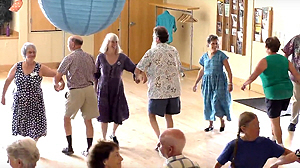
The Festival arrived, and they were superb. I don't think I've ever described a band's sound as “glorious” before, but theirs certainly was when that trumpet came in. On the last day of the Festival I tested their sight-reading skills by presenting them with the tune for this dance — a traditional song which I performed many times in the days when I was a Folk singer and guitarist. As I walked the dance through I realised that the third figure didn't progress — I'd used a full double figure eight. It was the final dance of the session and I had ten minutes left! People who were there will attest to the fact that I didn't panic. After a few seconds thought I told the dancers to do the figure eight and then “progress somehow” (which they did), but I'm glad to say I've since sorted things out — read more on my Composing Dances page. Click the image to see me calling the dance at Ann Arbor, Michigan in 2016.
Julia
Format: Longways duple improper Dance and Music: Colin Hume, 2011.| A: | Ones lead down, cast up. Twos lead up, cast down. |
| B | All back-to-back partner. Right-hand star ¾ to finish beside partner, ones on men's side, man on left of lady. |
| C: | Open ladies chain across and back (men start by casting out, and walk forwards the whole time) and on the final left-hand turn partner finish with ones below twos but well out from set position, men facing in, ladies out. |
| D: | Give two hands and poussette back into the longways set; set to partner. Turn single; two-hand turn half-way. |
Julia Day played fiddle with Wild Thyme and later played fiddle with Keeping Thyme and keyboard with (now disbanded) Contradition. In November 2011 Contradition were booked to play for me at my regular “House Party” weekend and Dave Brown pointed out that the Friday was Julia's 50th birthday and we ought to do something special. So I wrote the dance, Shane and Julia danced from the top of the set and Dave and I played the music on fiddle and keyboard while I called. It was suggested that a dance for Julia should not be one of my totally impossible ones, so this is more accessible than most, though I usually have to demonstrate getting from the open ladies' chain into position for the poussette and I have real trouble getting the men to walk forwards in the chain.
Key to the Cellar
Format: Longways triple.
Dance: Jenny Beer, 2004. Tune: Traditional Scottish. The tune is in three-time.
| A: | Ones cast, twos lead up; threes gate the ones down. Lines of three forward and back; twos gate the ones up. |
| B: | Ones go right (man down, lady up): reels of three across (12 steps). Ones gipsy right; all two-hand turn |
The tune is a traditional Scottish song, “Cam ye o'er from France?” and both the dance and tune can be quite hypnotic. If the twos and threes elongate their loop at the end of the reel (while the ones are doing their gipsy), they don't need to stop moving and everyone can do the two-hand turn at the same time.
This dance is in Scott Higgs' and Jenny Beer's book Key to the Cellar. There is also a dance called “The Key to the Cellar” in a book called “A Collection of the newest Country Dances performed in Scotland: written at Edinburgh” by David Young, 1740 which uses an extended version of the same tune but bears no resemblance to this dance.
Jenny's other dance on my site is Now Is the Month of Maying.
Lady Banbury's Hornpipe Lady Day Lady Doll St. Clair's Reel
The Lark in the Clear Air
Format: Longways duple.
Dance: Colin Hume, 2016. Tune: Traditional Irish. The tune is in three-time.
| A1: | First corners step Right, Left across in front, Right together, Left, Right across in front, Left together; two-hand turn. Wide cast left shoulder into neighbour's place (the others move left); meet for three steps, fall back. |
| A2: | Second corners now in first corners' place do the same, all finishing home. |
| B: | Ones cast, twos cross up into a full double figure eight (12 steps). Ones cast, twos lead up; all two-hand turn. |
I called this at several dances in New England including the New London Assembly in Connecticut where it was an immediate hit. The traditional Irish song is on an LP by Packie Byrne and Bonnie Shaljean, and when I was thinking I should write some new dances for my forthcoming trip to the States it suddenly popped into my head. The musicians liked the tune so much that they included it in their concert at the end of the week.
I really do want the stepping the way I've described it. It's not the normal 3-time setting, nor is it the “step-setting” that Tom Cook used for instance in his version of “Volpony” where the third beat is a step back. I want a wide movement, so the first three steps are to the right and the second three are to the left — move slightly behind your neighbour rather than taking tiny steps or hitting them. And make sure all the casts are wide, to use up all six steps.
Linda's Light
Format: Longways duple.Dance: Michael Wood, 2022. Music: Dave Wiesler, 2022.
The tune is in G Mixolydian, for those who worry about such things.
In 2022 several people on the ECD List wanted the notation and music, so I just linked to a PDF of the instructions and music. I've now done the job properly.
| A1 | 1-2 | Partners Swirly Siding L and back R, |
| 3 | Partners ½ Right hand turn | |
| 4 | Star R halfway, easing out to face neighbor on the side | |
| A2 | 1-2 | Neighbors (up and down) Swirly siding R and back L, |
| 3 | Neighbors ½ Left hand turn | |
| 4 | Star L halfway All end progressed and on opposite sides | |
| B | 1-4 | Poussette Hey: |
| 1s lead up and then join both hands and retain pousette position, dancing toward the (men's/larks'/L-file) side to begin the hey. 2s cast into the hey to begin. All end, again, progressed and on opposite sides | ||
| 5-6 | Double ½ figure of eight, 1s cross, 2s cast | |
| 7-8 | 1s lead down the center, turn to face up and fall back down the center. | |
| 9-10 | 1s lead up, turn to face down and fall back up the center to end facing new neighbors | |
| 11-12 | Circle Left once round with new neighbors | |
| 13-14 | Partners two-hand turn once round ending out on the sides |
Teaching Notes:The dance in is 4/4 and danced 4 steps per bar
B 1-4: In the hey, 1s keep hands as if they were dancing a poussette. The hey feels very much like a figure of eight for the 1s with measured movement. 2s can make a wide cast down into the hey and not just immediately move down the side of the dance.
B 4-5: At the end of the hey, 1s can keep inner hands briefly as they face up and cross up in the the half double figure of 8; 2s can continue their motion from the hey to cast down into the double figure of 8.
B 7-10: The 1s' track down the center and back is the same as in Ron Coxall's Turn of the Tide (though in 4 not in 6).
- Dancers should note the transition and change of direction between the two-hand turn at the end of the dance and the L-shoulder siding at the beginning of the dance.
- Neutral couples waiting out at the top should join the dance in B 7-8 when the 1s lead down the center.
- Neutral couples at the bottom should be ready to join the circle in B 11-12.
Love is Little
Format: Longways duple.Dance: Colin Hume, 2017. Music: Shaker hymn.
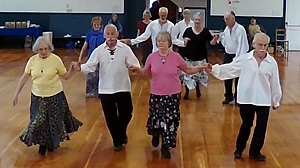
| A1: | All lead up a double and back. Ones cross and cast to the middle of a line of four while twos wait for them to cross, then lead up and cast onto the end of the line. |
| A2: | All lead up a double and back, bend the line. Circle left. |
| B1: | Men cross right shoulder; ladies the same. Fall back with neighbour; come forward and cloverleaf turn single away from neighbour. |
| B2: | Ones start three slow changes with hands, twos joining in on the second change (12 steps); all step right and honour partner. |
Mad Moll Maids Morris Major O'Flacherty Les Mariniers The Mask The Merry Milkmaids in Green
Michael and Gillian
Format: Longways duple.
Dance and Music: Colin Hume, 2015. The tune is in three-time.
| A1: | Ones gipsy right (6 steps); cast, twos lead up. Ones left-hand turn 1½. |
| A2: | Twos gipsy left; cast, ones lead up. Twos right-hand turn 1½ — all now improper. |
| B: | Second man hand partner up into double figure eight, ones cast into it (6 bars: 18 steps); take inside hand with neighbour and set (smoothly) to partner. |
| C: | First corner positions (first lady, second man) Hole in the Wall cross; the others repeat. Twos cast down and lead up as ones lead up and cast down. |
Dedicated to Mike and Gill Swash, and first called at the House Party Weekend in November 2015 with music by Contradition. One of Mike's favourite dances is Fried de Metz Herman's “Michael and All Angels” with music by Purcell. My tune may not compete with Purcell's, but the first half of the dance has strong similarities to Fried's without being too close — there's a fine line between honest admiration and plagiarism!
Mike has run the House Party Weekend for twenty years and this was his last. For the first four years he ran it with his wife Judy, then after her death he ran it for the next sixteen with Gill. It's my favourite weekend of the year — a chance to call a wide range of dances with excellent musicians and dancers.
And it all started with a cancellation! I was booked to call a dance week abroad somewhere: Wild Thyme were the band and Mike and Judy were the hosts. The week was cancelled for lack of support and we were all very disappointed, so Mike got in touch with Wendy Crouch who ran the Southam Gathering and they contacted everyone on both their lists of dancers to see who would be interested in a dance weekend. There was a good response and Wendy booked the Stoneythorpe hotel in Southam which was rather a “Fawlty Towers” venue. After a few years Mike transferred it to The Paddocks Hotel at Symonds Yat which is a terrific venue for both the ballroom and the support of the staff. And the food! The venue has changed hands twice since I wrote this, so that may not still be true!
From 2016 the weekend was run by Liz and John Felton, and I hope it will continue for a few more years.
Related dances are House Party Square, Symonds Yat, Mrs Felton's Maggot, Mr Felton's Retirement.
Money for Old Rope
Format: Longways duple minor, Twos improper Dance and Music: Colin Hume, 2019| A: | Men pass left shoulder: three changes of a reel of four (until you meet your neighbour). Two-hand turn neighbour 1¼ on the side, finishing with the man on the left. |
| B: | Circle left ¾ to finish on the side with partner, then change hands. Lead partner out a double; change hands and lead back. |
| C | Cross right shoulder with opposite, go well out, then a big loop left to come back in (8 steps in all). Right-hand star ¾ and fall back slightly from partner — just one step and together, without taking hands with neighbour. |
| D: | Four changes with hands — no courtesy turn — and men are ready to pass left shoulder with the next man. |
In the walkthrough it helps to start with the ladies stepping back and left so that the track of the opening reel is clearer. Don't let people rush any of the moves; the whole dance is designed to flow from one figure to the next.
I was commissioned to write this by Bridport Folk Dance Club who celebrated their 100th anniversary in 2019. My first attempt had the ones improper and the ladies passing right shoulder to start the reel, but two good men dancers wanted to do a reverse two-hand turn so obviously it didn't flow well for the men; this solves the problem. The club wanted a fairly sedate dance which they could also display, so the lead out with partner in B and the cross over in C give the audience a chance to see the dancers' faces rather than just their backs.
For hundreds of years Bridport was famous for making rope — see dorsetlife.co.uk/2011/
Mount Park
Format: Longways duple. Dance and Music: Ellen Taylor, 1981
| A: | (16 bars): 1st corners set moving forward; fall back. Pass clockwise round partner to change places. |
| 2nd corners set moving forward; fall back. Pass anticlockwise round opposite to change places. (All now progressed and improper.) | |
| B: | (16 bars): 1st couple half figure 8 up through 2nd couple. 2nd couple half figure 8 down through 1st couple. |
| : | Partners cross over passing right shoulder; loop to the left. Partners set; cross over passing right shoulder. |
Mr Brain's Favourite
Format: Longways duple. Dance: Francis Carter, about 1998, for Dennis Brain.
Music: Marin Marais — “Le Basque”.
| A1: | First corners back-to-back. Two-hand turn 1½. |
| A2: | Second corners the same. |
| B1: | (12 bars): Half double figure eight (ones cross up, twos cast to start). With the next couple, handy-hand turn (men right, ladies left). Face partner: set and turn single. |
| B2: | Ones lead up through original twos and cast back. With the next couple, circle left half-way; two-hand turn partner half-way. With that same couple, circle left half-way; two-hand turn partner half-way. |
Dennis Brain was the top horn player in the world for many years. He often played this piece as an encore. Francis says it's necessary to stress that the dance is a single progression, not double.
Mr Isaac's Maggot Mr Lane's Trumpet-Minuet
Mrs Felton's Maggot
Format: Longways duple. Dance and Music: Colin Hume, 2006
| A: | Second corners Hole-in-the-Wall cross; circle left ¾. Original first corners (now in second corners' place) Hole-in-the-Wall cross; circle left ¾ (home). |
| B: | Ones cross and cast, twos meet, lead up and turn out; symmetrical back-to-back with neighbour: ones lead up to start. Ones half figure eight up while twos move down the outside and lead up; all two-hand turn partner. |
First danced at Liz Felton's 50th Birthday Dance in October 2006, with music from Contradition.
Liz and her husband John are such beautiful dancers that it's always a pleasure to watch them dancing together. One of Liz's suggestions for the programme was Playford's classic “Mr Beveridge's Maggot”, and the dance and tune were inspired by that. It can even be danced to a recording of “Mr Beveridge's Maggot”, provided you use one intended for Pat Shaw's interpretation which (correctly) has only one B, unlike Cecil Sharp's. But you don't need to do that now — there's a recording by Dampier's Round on their Spring Blossom CD.
I originally wrote it with the corners the other way round in A1, but in both cases the previous move (the two-hand turn at the end of the dance and the circle left ¾ after the first cross) leaves the people in first corner positions moving out of the minor set and the people in second corner positions moving towards each other, so the modification improves the flow.
Apologies to Jonathan Jensen — I've borrowed a musical phrase from one of his tunes (and if you don't know which, I'm not going to tell you). I tried three other versions of the tune, but the band and I thought that none of them was as good as the original, so I've gone back to that.
Later Liz commissioned me to write Mr Felton's Retirement.
The Music Will Tell You
Format: Longways duple minor improperDance and both tunes: Colin Hume, 2006
| A1: | (24 steps): Ladies cast left shoulder, behind neighbour, cross left, behind partner (12 steps). Two-hand turn opposite 1½ and circle left half-way (12 steps). |
| A2: | Men cast left shoulder, behind partner, cross left, behind neighbour. Two-hand turn partner 1½, circle left half-way. [Progressed, twos improper, ones proper.] |
| B1: | (24 steps): Right-hand turn partner ¾ to a wave up and down, then ladies left-hand turn 1½ as men orbit to meet partner at the other end of the wave (12 steps). Back-to-back partner (6 steps); pass through, California twirl neighbour (6 steps). [Progressed, twos proper, ones improper.] |
| B2: | Right-hand turn partner ¾ to a wave up and down, then men left-hand turn 1½ as ladies orbit to meet partner at the other end of the wave. Back-to-back partner. Face out, California twirl neighbour. |
The idea is that the band switches smoothly from one tune to the other at the caller's request, and the dancers adapt their style accordingly — the music should tell them! See the notes on the session for which I wrote this dance.
The dance worked fine when I called it at Southam, but some people found the slow tune too slow and the fast tune too fast, and some found the slow tune too miserable. This is a revised version of the tune — nobody has complained yet. But it's never been that successful and it puts a lot of strain on the musicians, so I probably won't call it again.
New London Assembly
Format: Longways duple minor. Dance and Music: Colin Hume, 2016.| A: | (20 bars): Up a double and back. Ones cast (twos lead up slightly) and cross below twos to finish on the end of a line. Up a double and back. Face neighbour: half a hey. Two-hand turn neighbour 1¼ to finish with men above ladies. |
| B: | (20 bars): First couple cross (on the diagonal); second couple cross. Circle left ¾ (all improper but not opposite partner). ¾ double figure eight across — the twos always cross in front of the ones, so it starts with the second lady in the lead, ladies crossing through men, men moving across outside the ladies (8 bars). All two-hand turn partner. |
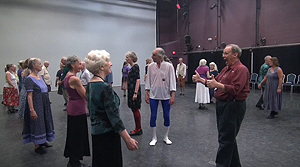
Shira (who has a foot in both camps) arranged for some of the early music players to join the band for the dance's premiere. I was afraid that Brad would say the dance was too complicated for an evening dance, but people coped well with it and seemed to like it.
The video on the right (courtesy of Paul Ross) shows the first performance, and you will also hear Deirdre Rees accusing me of stealing the double figure eight across the set from Scottish Country Dancing. Later she sent me the instructions for the dance “Glayva” by John Drewry, written in 1976, which introduces the “Espagnole” as “a new method of progression” (something the Scots seem to be very keen on). This is a half double figure eight across the set followed by a handy-hand turn with partner. He explains it in great detail and then adds: “The progression is merely the figure of bars 1-16 turned through 90º”, and indeed he describes bars 1-4 as “1st and 2nd couples dance half a double figure of eight”. I've never heard of this dance or the Espagnole, and mine is a three-quarters double figure of eight rather than half, so I deny the charge!
I originally wrote the music out with 4 steps to the bar — something I never do, but there were so many long notes I thought I'd try it. It confused the musicians, so I've now changed it to my usual 2 steps per bar. People said the tempo (minim / half-note = 109) was too fast, so I'm now trying minim = 100. The music links above give one version with melody and piano, and another in four-part harmony.
New Minuet / Trumpet Min…New Minuet / Trumpet Minuet
Now is the Month of Maying Updated 23-May-25
Format: Longways duple minor. Updated 23-May-25Dance: Jenny Beer, 1997. Music: Thomas Morley, 1595.
| A1: | First corners set moving forward; turn single. All change places right shoulder with partner and then dance single file clockwise round the outside of the set to end progressed and proper. |
| A2: | Second corners (now in first corner positions) the same, all ending in original places. |
| B1: | Women half figure eight through the men — first woman go first. (The posts move, as in a mirror image back to back). Half poussette anti-clockwise with opposite (first man pull, second man push). |
| B2: | Men half figure eight through the women — first man go first. Half poussette anticlockwise with partner (again first man pull, second man push). |
First published in CDSS News 147, March/April 1999, page 15.
A nice dance to the well-known madrigal. Jenny is now back in Philadelphia, though for several years she lived in California. People have real trouble finishing A1 on their proper side, so a demonstration might be in order. I find it helps to say that the people not doing the set and turn single don't wait until their partner has passed them: they immediately cross to their partner's place and tuck in behind them. Jenny wrote it as above, but she finds that in B2 the second man wants to lead the half figure eight (even though at this point he is moving backwards and the first man is moving forwards) so she says you may find it easier to let him do so.
Jenny has now drastically changed the second half of the dance, as follows:
| B1: | Women half figure eight through the men — second woman go first. Women through the men: Handy-hand turn opposite. |
| B2: | Men reverse half figure eight: go outside the women and then cross through them to finish opposite partner. Women through the men: Handy-hand turn partner. |
No doubt Jenny thinks this flows better, but I still prefer the original version and will continue to teach it! The revised version is in Scott Higgs' and Jenny Beer's book Key to the Cellar.
Jenny's other dance on my site is Key to the Cellar.
The Olive Grove
Format: Longways duple minor.Dance: Elaine Beckingham, Music: Childgrove (Playford)
| A1: | Lead up a double; cast back to place. Lead down a double; cast up to place. |
| A2: | First corners back-to-back. Second corners back-to-back. |
| B1: | Double figure of eight: ones cast, twos cross up to start — at the end, first man loop to the right - |
| B2: | First corners cross; second corners cross. All two-hand turn partner 1½ (dance). |
The Opera, or The Apes Da…The Opera, or The Apes Dance Orleans Baffled
Pachelbel's Canon
Format: Longways duple minor improper double progression.Dance: Colin Hume, 2002. Music: Pachelbel or Colin Hume
| A1: | Ones down a double and back twice // Twos stand apart. |
| A2: | Ones face partner: fall back a double; move forward // Twos up a double and back. Ones turn single down; right-hand turn half-way // Twos up a double and back. |
| B1: | Ones half figure eight down // Twos face partner: fall back a double; move forward. Ones half figure eight up — Twos turn single up; right-hand turn half-way. |
| B2: | Ones step right and honour partner; cross left [Home] // Twos half figure eight up. Ones step left and honour; separate and go down outside twos to next ones' place // Twos half figure eight down. [First progression] |
| Twos becoming neutral instantly change to ones — you don't do the step and honours. You are already on the correct side, but make each “Down a double” small and the fall back as normal. | |
| Ones becoming neutral wait while the existing ones do their first down a double and back. As they do the second, two-hand turn half-way to become proper, face down and fall back. | |
| A1: | Ones down a double and back // Twos step right and honour partner; cross left. Ones down a double and back // Twos separate and go up above these ones to next twos' place. |
You don't want to do this dance! You want Ted meets Pachelbel further down the page.
Carol Hewson commissioned me to write a dance to Pachelbel's Canon, and originally specified that she wanted the dance to be in canon, just as the tune is. I soon realised that there were only two possible ways to do this in longways duple minor format. Either you have the first corners working together and the second corners working together, or you have the ones working together and the twos working together. Since Pat Shaw had already used the first approach very successfully in “John Tallis's Canon”, I decided on the second approach.
I tried this with good dancers, and it was complete chaos. Trevor Monson gave me a couple of useful hints about simplifying things, but I tried it a second time with good dancers and again it fell apart — so I gave up. You're welcome to try it out, and please let me know how you got on, but don't ask me to call it again!
Paul's Alley Portsmouth The Prince's Favourite The Princess The Punch-Bowl Pye Corner Red-House Sabina
Saint Louis
Format: Longways duple minor. Dance and Music: Colin Hume, 2007.| A1: | All lead up three steps and fall back; ones cross and cast, twos lead up. All fall back with neighbour three steps, lead forward; ones two-hand turn (6 steps). |
| A2: | Same but with twos active — all finish improper. |
| B1: | 1M 2L (in second corner positions) cross (3 steps), other corners cross; circle left half-way. Three-quarters of a double figure eight — ones cast and twos cross up to start — finishing with twos above, improper, facing out, ones below, proper, facing in. |
| B2: | Ones come up the centre into a symmetrical gipsy with neighbour 1¼ and twos keep turning to form a line facing up: from left, 2L, 1M, 1L, 2M (6 steps); lead up three steps and fall back. Twos gate the ones up and round to progressed place (6 steps); twos Hole-in-the-Wall cross while ones turn single downwards (6 steps). |
Written in January 2007 while I was staying with John Ramsay and Berni Meyer, and first danced that evening at a rehearsal of their performance group Dance Discovery with the music played by their band Tu'penny Uprights. On that occasion I did not have the lead up and back in B2, and there seemed to be too much music, so I've since added it. That makes the gipsy quite tight — six steps to go round one and a quarter — so get in close! Dedicated to John, Berni and all the people who looked after me and the groups I called for: in addition to a workshop for Dance Discovery (for which I also played piano) I called an English Ball for St Louis English Country Dancers and a contra dance for Childgrove Country Dancers.
Pronunciation note for dancers in England: Saint Louis was founded by the French, and no doubt pronounced “Sa' Loo-EE”. In England we would say “S'nt LOO-ee”, but in the States it's “SAINT Lewis” with the accent firmly on the first word.
Salute to Southam
Format: Longways duple minor.Dance and Music: Colin Hume, 2002. You can also use “Jack's Maggot”.
| A1: | First man half a hey with the ladies. First man and second lady right-hand turn: the man ends home and the ladies end progressed. |
| A2: | Second man half a hey with the ladies. Twos left-hand turn: all end home. [All danced with a skip-change step.] |
| B1: | First corners cross; all single file one place clockwise (to progressed place). Back-to-back partner. |
| B2: | Second corners (now in first corners' place) cross; single file one place (home). Dance three changes with hands. |
In A1 and A2 the man needs to come out of the hey wide, or he will give the wrong hand to the lady. The B part is all simple moves, but not necessarily in the order which the dancers expect!
First danced at the Southam Gathering, August 2002. This was started by Wendy Crouch (later Wendy Knight) and was an immediate success; everybody knew that with Wendy in charge it would be well organised. The organisation was passed on to Gill Swash and Chris Bower in 2002 and others later, and all have kept the successful formula already established — they keep booking me so I'm not complaining! If you're looking for a three-day dancers' festival over the August Bank Holiday, Southam in Warwickshire is the place to be — but it's invitation only!
Spring Blossom
Format: Longways duple minor improper Dance and Music: Colin Hume, 2008. Dance rewritten 2010.
| A: | Ones cross and cast; twos wait and then lead up. Ones two-hand turn all the way while twos set to partner and then cast, finishing in a line of four facing up with the ones in the middle. |
| B: | Up a double and back. Twos gate the ones up and round into progressed place proper. |
| C: | Double figure eight: twos cast, ones cross up to start. |
| D: | Left-hand star. Ones half figure eight up (man hand the lady up into it, left hand in left). |
I wanted a straightforward dance for the title track of the Dampier's Round CD, but I failed completely, so a couple of years later I came up with the above which I hope is the final version. Trevor Monson and Robert Moir still prefer the version below, because it's different from other dances, and of course I'm happy for people to call that if they prefer it. I'm giving the above version the generic name “Spring Blossom”, or if you want to be specific you can call it “Late Spring Blossom”.
Here's the version which was on the website until April 2010, now known as “Early Spring Blossom”.
Format: Longways duple minor — Double progression.
Dance and Music: Colin Hume, 2008.
| A: | Ones cross (I suggest left shoulder) and cast; twos wait and then lead up. Ones two-hand turn all the way while twos do a wide cast, finishing in a line of four facing up with the ones in the middle. |
| B: | Up a double and back. Twos gate the ones up and round into progressed place improper. |
| C: | Ones pass partner left shoulder to start a diagonal hey for four (second change is same sex person right shoulder, first man up to original second man, first lady down to new second lady) — ones are working with their partner, twos are not. |
| D: | Ones left-hand turn to your own side; first man cross left shoulder with the new second lady. In these new fours, left-hand star ¾ to progressed place, ones ready to cross left shoulder and dance with a new couple — this is a double progression dance. |
I thought this was simple, but you're reading version seven of the second half of the dance — you should have seen version 1 where the ones do a diagonal hey while the twos do a straight hey! I suggest that after you teach the gates movement you ask the ones to move forward so that they are left shoulder to left, and then face diagonally right, so that it's clear who is in the diagonal reel of four. At the bottom of the set (unless you started with a neutral couple) it will be a reel of three, with the first lady looping left to do the next change left shoulder with partner, though if this confuses people they can just stand still. The top lady does nothing. It may be worth pointing out that in A and B the ones are working with their original twos, in C they are working with the original second man and the new second lady (who have each other as a shadow) and in D they are working with their new twos, before moving on to yet another second couple at the start of the next turn of the dance.
La Tambourine
 Format: Longways duple.
Dance: Colin Hume, 2018. Music: Anonymous, late 18th century
| A1: | First corners set; turn single. Gipsy right 1½. |
| A2: | Second corners as much. |
| B1: | All fall back a double with neighbour; lead forward. Dance three changes with hands. |
| B2: | All fall back a double with neighbour; lead forward. Ones cast, twos lead up; all two-hand turn half-way. |
I came across this tune on the Vaughan Williams Memorial Library website. I really liked it, and it didn't have an associated dance, so being a tambourine player myself — see Colin's Tambourine — I decided to write one. It was first performed at a Zesty Playford session at Chippenham Folk Festival in 2018, with zesty music from Pendragon, and their leader John Dudley said that my tambourine playing really improved the music! There's an excellent recording by the Odd Sundays Garage Band at bacds.org/odd-sundays.
Tango in Toronto
Format: Longways duple. Dance and Music: Colin Hume, 2010
| A1: | (16 bars) First man advance, second lady retreat; reverse. Gipsy left, give a meaningful look then spin round to the right. |
| Right-hand star, transferring the hand-hold to your partner at the end. Right-hand turn partner half-way; turn single left. | |
| A2: | First lady advance, second man retreat; reverse. Gipsy right, give a meaningful look then spin round to the left. |
| Left-hand star. Left-hand turn partner half-way; turn single right. | |
| B: | First corners pass right shoulder: half a straight hey (and I mean straight across, not on the diagonal). First corners gipsy right to face same-sex neighbour while the others do a slow loop to their left. |
| Pass neighbour left shoulder: half a straight hey to finish in progressed positions. Single file clockwise. |
People have real trouble getting into the first hey and getting out of the second hey, neither of which does what you expect. At the start the first corners are walking almost straight ahead for the first two changes, passing each other right shoulder and then their partners left shoulder. It might help in the walk-through for the second corners to take a step back and left. It might even be better to describe it as three changes of a hey starting left shoulder with partner. At the end the second corners do only two changes, then move out to their progressed position and turn to their right as the first corners pass right shoulder into their progressed position and also turn to their right to follow their same-sex neighbour into the single-file circle (which needs to be tight). The second corners are following their partner. It might help to get the dancers into their progressed positions (facing the right way) before starting the heys, so that they know where they are aiming for. Trust me — it does work! If you're teaching the dance I suggest you demonstrate it as a second corner, so you can show that you finish the hey in your progressed place, turn right and start moving in the single-file without getting in the way of the first corners who have yet to pass right shoulder with each other and then turn right to follow their same-sex neighbour. You may find that they can't cope with passing right shoulder with each other, being too desperate to follow their neighbour; it depends how fussy you want to be.
Keith Wood has an animation of the dance at dancekaleidoscope.
But some time after writing the dance I had an e-mail from Jean Causey in Seattle who said:
Tango in Toronto is a special dance. Great fun. Great music. Great concept. Great A part. But it doesn't get on programs because the B part requires special teaching, and then dances muddled anyhow.I know that the B part works. I respect its design. But in the real world, the difference between “works-technically” and “succeeds” is limiting usage of the dance. So I tampered with the B. There are some mighty fine dances just sitting on the shelf because they turned out to be “workshop” dances. Seems to me that it would be reasonable in this case for the dance to retain its original form for special occasions, and also to have an “everyday” variant, so long as that variant does not subvert the essential core of the original.
When I first heard that someone had called the dance at Mendocino a week after I had introduced it and had changed the ending, I thought “What a nerve! If they're calling my dance, they call it the way I wrote it!”. But I take Jean's point — you can see on the video how much trouble I had teaching it — so here's her modification which you're welcome to call — though I still prefer the original.
| B: | First corners pass right shoulder: a complete straight hey. |
| First corners do one extra change to meet partner, gipsy left with partner just over once around (to finish on the side of the set), then first corners lead partner into a single file clockwise ¼ to progressed places. |
Another modification, used at the Baltimore Playford Ball in 2014 which is held in a narrow hall, is to change the final single file circle to a gipsy right with partner. This would also help if people are late finishing the hey!
In 2014, Gene Murrow told me he had taught the dance successfully to a floor full of contra dancers at English-American week at Pinewoods. He says:
Before teaching the hey, I have everyone switch with neighbor and face for the single file circle. I say “this is where you're heading.” As I was about to teach the hey, I muttered something like, “and now comes a hey for 4 with a boomerang turn-about for the first corners in the middle, which goes like this… ending in the circle we made just now.” Well, before I could “teach” it, they had already done it! I realized that by keeping it very simple, people get it. It's simply a “hey for 4 across the dance, first corners start by passing R shoulder…” Just as you wrote in your original directions!! I and others got confused by trying to analyze it (or by watching that hilarious YouTube video of you in Toronto) :-) .So there it is. I've shared my “contra secret” with other callers in the States, and they agree it has helped them present this terrific dance.
 For Karen Millyard and Bridget Whitehead, two of the organisers of the English Country Dance Conference and Dance Weekend in Toronto in 2010. They both worked themselves to exhaustion to produce two successful events. They are also both keen on Argentine Tango, so I decided to write a tango-style English Country Dance. I was staying in the apartment of Karen's grandmother who had been a concert pianist, and wrote the tune at her beautiful grand piano: I know Argentine Tango does not use the stylised rhythm of ballroom tango, but I wanted something which ordinary dancers would recognise as a tango. The band was Foxfire — Daron Douglas and Karen Axelrod — and I had heard them playing tangos at Brasstown in 2008 so I knew they would make a great job of it.
People responded enthusiastically in Toronto, and asked for it to be repeated in the final dance, though Fae Fuerst who danced it both times said:
At the moment I think passing right shoulders to start the tango hey is a choreographic blunder, not the kind of awkward iconoclasm we'll get used to.Here's a video of the first attempt, in 5 parts:
Toronto, 2010
Toronto, 2010
Toronto, 2010
Toronto, 2010
Toronto, 2010
Berea, Kentucky, 2017
Ted meets Pachelbel
Format: Longways duple.Dance: Colin Hume, 2002. Music: Pachelbel or Colin Hume
| A1: | Ones lead down a double; turn in and lead back. Ones quick cast and cross while twos lead up a double and fall back. |
| A2: | Lead up in a line of four (ones on the ends); two-hand turn neighbour (4 bars, across the musical phrase); lead down a double. |
| B1: | Wheel around with neighbour (men going backwards) to face up; ladies move up while men turn single right ¾. All single file clockwise ¾ to finish improper (second lady and first man at the top). |
| B2: | Ones two-hand turn half-way, first man pick up the second lady and circle left half-way, first man pick up the second man and all circle left to progressed places, acknowledge the other couple before leaving them. |
| [The turn and the first circle don't take very long, so take your time on the final circle to use the music up, and acknowledge the other couple before starting the next turn of the dance.] | |
 The dance can be done to “Pachelbel's Canon” — it will run seven times through. Musicians will need to add a two-note introduction, as the dancers start moving on the first beat of Pachelbel's music, so the first A1 is danced to the eight slow chords and the first melody instrument comes in as the dancers start A2. In case you don't have a recording or a band willing and able to play this, I have also provided my own tune. Please note that Pachelbel's tune as written has four beats to the bar whereas mine has two. This means that with Pachelbel's tune each paragraph is only four bars, and a semicolon marks a one-bar phrase. I think about 168 beats per minute would be a good speed. If you use the first link above you'll see I've rewritten Pachelbel's tune with two beats to the bar.
Written for Ted Hewson and commissioned by his wife Carol for his 65th birthday in 2002 — I called it for them a few days after Ted's birthday at the Weekend Whirligig in New York State, with Bare Necessities playing the music. It was also danced at the Washington DC Ball in Autumn 2004, and caused people some problems! But not nearly as many as would have been caused by my original dance to Pachelbel's Canon!
Three Heys in May
 Format: Longways duple. Dance and Music: Colin Hume, 2020. The tune is in triple-time.
| A1: | Ones right-hand turn (6 steps), man hand partner down into a hey for three across the set, the ones acting as unit, passing second man right shoulder to start, finishing home with the ones improper (18 steps). |
| A2: | Twos left-hand turn, man hand partner up into a hey for three across the set, twos acting as a unit, passing first lady left shoulder, all finishing home and improper. |
| B: | Right-hand star (9 steps), turn single out of the star. Left-hand star, turn single out. |
| C: | First corner positions (first lady and second man) Hole in the Wall cross; second corner positions the same. Four changes, no hands, 3 steps per change. |
Written for the much delayed Playford Dance Competition at May Heydays in Evesham in 2022, where it won second prize. See all eight entries at mayheydays.org.uk/dance22.html and click the image to see it being danced at the Competition.
Three Weddings
Format: Longways duple. Dance and Music: Colin Hume, 2007 | A1: | First corners right-hand turn 1¼, keep hold, and give left to partner in diagonal wave. Set in the wave; left-hand turn partner half-way so that second corners face each other. |
| A2: | Second corners pass right shoulder: diagonal hey for four so that they again end facing each other. |
| B1: | Second corners right-hand turn about ¾ to a long wave (of second corners) down the centre facing partner; all set. Second corners push: half poussette with partner to finish progressed and improper. |
| B2: | First corners right-hand turn about ½ to a long wave (of first corners) facing neighbour; all set. Second corners cast right shoulder, first corners follow neighbour: single-file ¾ to progressed place — first corners turn right to face partner at the end of the figure. |
Tim on the March
Format: Longways duple improperDance: Carol Hewson, 2002. Music: Judi Morningstar.
| A1: | Right-hand star half-way, then left-hand turn new neighbour all the way (in only 4 steps). Original fours right-hand star half-way, then left-hand turn previous neighbour all the way. |
| A2: | Double figure eight in original fours: ones cross down, twos move up the outside to start. [Home] |
| B1: | Ladies cross; men cross. Circle left half-way; ones cast, twos lead up. |
| B2: | Ones lead up and cast. Twos lead down and cast up. |
| Don't change sides as soon as you're out at the end — wait until the double figure eight. | |
Written for Watendone Folk Dance Club's 40th Birthday Party. The music is a great tune — “March of St. Timothy”, published in the book “Legacy” published by the Country Dance and Song Society and also in “The Portland Collection”.
The A1 section is very quick — you need to face out of the star and give some weight in the turns, and be ready to move straight into the double figure eight.
A Trip to Morland
Format: Longways triple minor. Dance and Music: Colin Hume, 1986. The tune is in three-time.
First published in Dances with a Difference, Volume 3.
| A1: | Circle six left half-way (6 steps); take hands along the length of the set, fall back (3 steps), come forward (3 steps). Back to back partner; two-hand turn half-way, fall back. |
| A2: | Top man bottom lady two-hand turn half-way and fall back into each other's place (6 steps); top lady bottom man the same. Middles two-hand turn half-way (3 steps) and face down, bottom couple cast up into two stars (men left-hand, ladies right-hand) which go once around (9 steps). |
| B: | Ones lead down, followed by threes and twos as they meet their partner at the top (9 steps), cast up from the bottom and move back up (leading up once you've passed the other couples) (9 steps), ones cast to middle position (6 steps). (All improper, order 3, 1, 2.) |
| C: | All on the right diagonal right-hand turn (taking in those in the next minor set but ignoring any neutrals — 6 steps); on the left diagonal left-hand turn (6 steps). Circle six to the right half-way; take hands along the length of the set, fall back (3 steps), come forward (3 steps). |
Unless there is plenty of room, have just the ones turning on the diagonals, i.e. keep within the minor set. This also avoids confusion about who is involved in the circle right.
Written for the first Morland Folk Dance Week, August 1986, in the Eden Valley, Cumbria, with Cumbrian Gap.
Ian Jones and I shared the calling. This was a mixed blessing — and not just because Ian insults me as much as I insult him. I find it quite an effort to call a dance like Pat Shaw's “Clarance House”, so it came as a shock to find that Ian could do this while leading the band. However, I'm reliably informed that he takes his accordion off when calling some of my dances! Cumbrian Gap are also the only Band I know who will happily split in half and play for two different workshops. The Morland Folk Dance Week continues to play to packed houses, and I've been asked back every year so far…. My thanks to the Joneses of Cumbrian Gap: Ian, Margaret, David and Jenny, plus good old Jack on the drums, for making the weeks such a pleasure for me and everyone else.
Wakefield Hunt Walbrook Well-Hall Whimbleton House Whitney's Farewell
The Windrush
Dance and Music: Jill Lawrence, 1983.Format: Longways duple minor
| A1: | First corners cross right; second corners cross right. All arm right neighbour once round; turn single left. |
| A2: | Second corners cross right; first corners cross right. All arm right partner once round; turn single left. |
| B1: | Ones give two hands and do four slips down the middle while twos slip up the outside; reverse with twos slipping down the middle. Ones cross and cast; twos lead up and separate. |
| B2: | With the next neighbour, handy-hand turn (ones through the middle). Ones go straight into half figure eight up through original twos. |
In A2 the second corners are still in second corner position, so don't ask “people or positions?”, and the first corners' cross leaves you facing your partner. The arm right is quicker than you might think!
Note: The Windrush is the river which flows through Bourton-on-the Water, Gloucestershire.